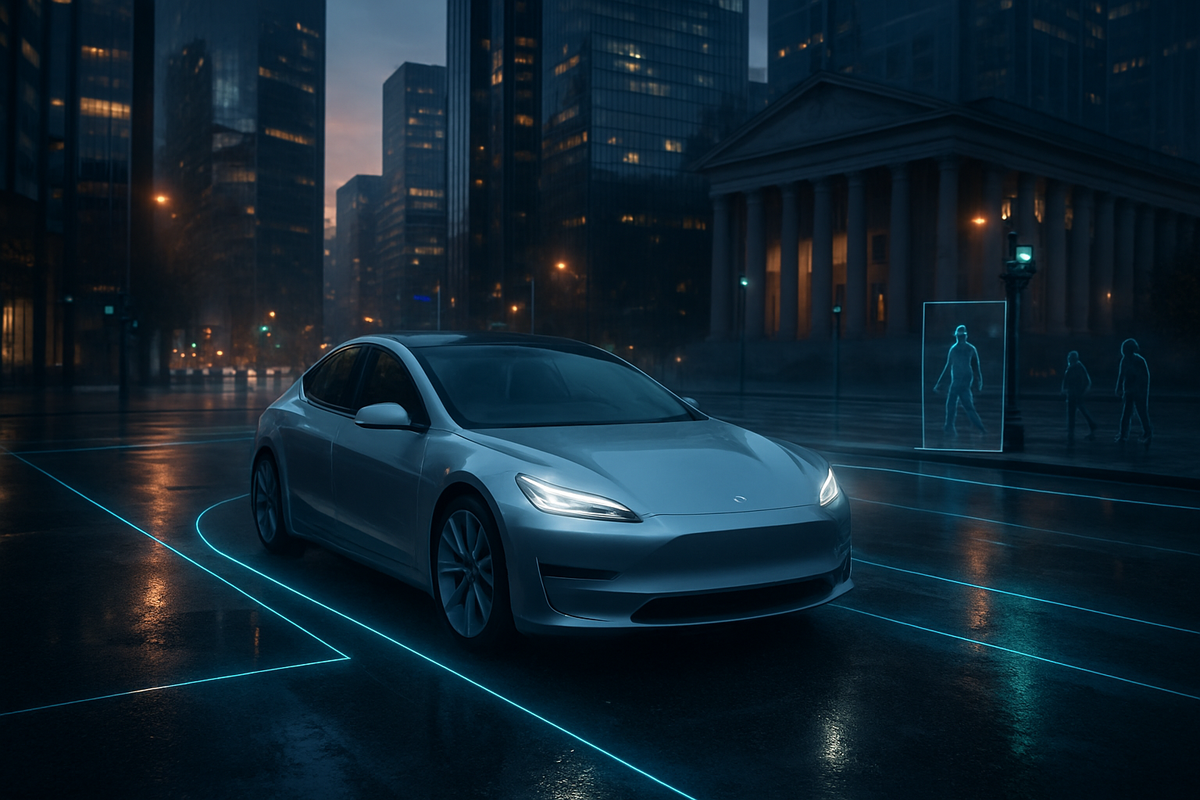
In a move that has provided temporary breathing room for the world’s most valuable automaker, the National Highway Traffic Safety Administration (NHTSA) granted Tesla (NASDAQ: TSLA) a five-week extension on Friday, January 16, 2026. The reprieve concerns a high-stakes federal investigation into potential traffic-law violations by the company’s Full Self-Driving (FSD) software. Originally facing a mid-January deadline to supply exhaustive data on nearly 3 million vehicles, Tesla now has until February 23, 2026, to provide records on thousands of incidents involving red-light violations and illegal maneuvers.
The immediate implications of this extension are profound for Tesla’s 2026 roadmap. By pushing back the regulatory reckoning, Tesla avoids a potentially damaging preliminary finding during a critical quarter as it prepares for the high-profile launch of its "Cybercab" robotaxi. The market reacted with a cautious sigh of relief, as the stock saw a 1% uptick in early trading, signaling that investors view the extra time as an opportunity for the company to better frame its safety narrative under an increasingly favorable federal regulatory environment.
The current standoff began in October 2025, when the NHTSA opened a Preliminary Evaluation into roughly 2.88 million Tesla vehicles equipped with FSD. This specific probe was triggered by reports of software-induced traffic violations, including cars entering one-way streets the wrong way and failing to yield at busy intersections. To evaluate the systemic nature of these risks, the agency demanded that Tesla manually review and report on 8,313 potential incident records—a task Tesla legal counsel argued was "unduly burdensome" and technically exhaustive to complete by the original mid-January 2026 cut-off.
This reprieve follows a tumultuous timeline for Tesla’s autonomous ambitions. Throughout late 2024 and 2025, the company faced a series of overlapping investigations, including a probe into FSD’s performance in low-visibility conditions like fog and sun glare. However, the tide began to turn in April 2025, when the Department of Transportation revised crash-reporting requirements, allowing manufacturers to skip reporting for minor, non-fatal accidents. This earlier policy shift, coupled with today's extension, suggests a broader softening of federal pressure as the administration prioritizes American leadership in autonomous technology.
Key stakeholders, including CEO Elon Musk and the newly empowered Department of Government Efficiency (DOGE), have been vocal about the need to "slash red tape" that hinders AI-driven transit. While the NHTSA continues to emphasize its commitment to safety, the procedural delay is being interpreted by industry watchers as a sign that the agency is willing to engage in a more collaborative, rather than purely adversarial, relationship with the EV giant in the current political climate.
The primary beneficiary of this regulatory breathing room is undoubtedly Tesla (NASDAQ: TSLA). The extension preserves the company's momentum as it scales its "supervised" FSD v13 and prepares for a pivot to fully unsupervised operations. If the NHTSA had forced a faster deadline, a negative preliminary finding could have derailed the anticipated April 2026 Cybercab volume production at Gigafactory Texas. For Tesla, this is not just a legal win; it is a strategic shield for its highest-margin future product.
Conversely, traditional competitors and established ride-hailing platforms may find this reprieve unsettling. Alphabet (NASDAQ: GOOGL), through its Waymo subsidiary, has long maintained a "safety-first" lead with its Lidar-heavy sensor suites and millions of driverless miles. As Tesla receives more time and faces less stringent reporting standards, the technical and cost advantage of Tesla’s camera-only approach—projected to cost as little as $0.81 per mile—could erode Waymo’s premium market position. General Motors (NYSE: GM), which has struggled to regain its footing with Cruise, also loses the relative advantage that strict federal scrutiny once imposed on its more aggressive rival.
Uber (NYSE: UBER) finds itself in a complex position. While it has transitioned into an "asset-lite" aggregator, partnering with both Waymo and international AV firms, a faster-than-expected "unsupervised" rollout from Tesla poses a direct threat to Uber's network effects. If the "Tesla Network" of owner-operated robotaxis launches with federal blessing in 2026, Uber may face its first true existential threat since its inception. Meanwhile, Ford (NYSE: F), which shifted its focus toward Level 2 and Level 3 driver assistance, risks being left behind if the regulatory "reprieve" for Tesla accelerates the path to true Level 4 autonomy for consumer vehicles.
This event fits into a much larger trend of "regulatory competition" between the United States and China. Federal policymakers are increasingly wary of the rapid progress made by Chinese AV firms like BYD and Nio. The reprieve for Tesla, alongside the proposed "SELF DRIVE Act of 2026," signals a shift toward a national framework for autonomous vehicles that would preempt state-level restrictions. For years, California’s DMV and other state agencies have acted as the primary watchdogs for AV safety; however, the federal government's decision to grant Tesla extra time suggests a move toward a single, more permissive national standard.
Historical precedents, such as the 2024 closure of the Autopilot "Autostrike" investigation, showed that Tesla could often resolve massive federal probes with software over-the-air (OTA) updates. This current reprieve suggests that the NHTSA may once again be looking for a path toward a "remedial" rather than "punitive" outcome. The wider significance lies in the precedent it sets: if the U.S. government prioritizes the speed of deployment over granular incident reporting, it could trigger a "race to the bottom" or a "race to the top" in safety standards, depending on whether the technology truly matures in the coming months.
Furthermore, the ripple effect on the AI sector is significant. As Tesla is granted leniency, other AI-heavy industries may lobby for similar "data review extensions" when faced with government audits. This marks a pivot in the regulatory philosophy of the 2020s—from the "move fast and break things" era to a "move fast with federal oversight" era, where the definition of "oversight" is increasingly influenced by geopolitical stakes.
In the short term, all eyes remain on February 23, 2026. Tesla must provide a data package that proves FSD is not fundamentally prone to violating traffic laws. If the data shows a clear downward trend in "disengagements" and illegal maneuvers, the probe may be downgraded or closed by mid-2026. However, if the data reveals systemic flaws, the extension will have only delayed an inevitable massive recall that could force a redesign of the FSD neural architecture.
Long-term, the strategic pivot is clear: Tesla is moving toward a "Cybercab-first" business model. The regulatory environment is being reshaped to support this, with a proposed increase in vehicle exemptions—from 2,500 to 90,000 units annually—for cars without steering wheels. This would allow Tesla to dominate the domestic robotaxi market before competitors can scale. Investors should prepare for a potential "dual-track" reality: a lenient federal landscape contrasted with aggressive legal challenges from states like California, which recently threatened a sales suspension for Tesla over "false advertising" claims.
The ultimate scenario for Tesla is the "Coast-to-Coast" unsupervised FSD release by late 2026. If today's reprieve is the first of many regulatory hurdles to fall, the "Tesla Network" could go live with a fleet size that dwarfs all competitors combined. The challenge, however, will be maintaining public trust. A single high-profile accident during this "reprieve" period could reverse the current regulatory goodwill and spark a backlash that no amount of federal lobbying could suppress.
The January 16 reprieve is a landmark moment in the "Robotaxi Wars" of 2026. It underscores the shifting power dynamics between Silicon Valley and Washington, where the urgency to maintain a technological edge over global rivals is beginning to outweigh the granular safety scrutiny of previous years. For Tesla, the five-week extension is a vital tactical win, allowing it to synchronize its regulatory defense with its product offensive.
Moving forward, the market will likely remain volatile as the February 23 deadline approaches. Investors should watch for any leaks regarding the 8,313 incident records and monitor the progress of the SELF DRIVE Act in Congress. The true measure of this reprieve’s value will not be found in the extra weeks of data review, but in whether Tesla can use this time to prove that its vision-based autonomy is ready for the "unsupervised" world.
As 2026 unfolds, the intersection of AI, federal policy, and automotive engineering will define the next decade of American transport. For now, Tesla has been given the time it asked for—but the clock is ticking faster than ever on the company’s promise of a driverless future.
This content is intended for informational purposes only and is not financial advice.