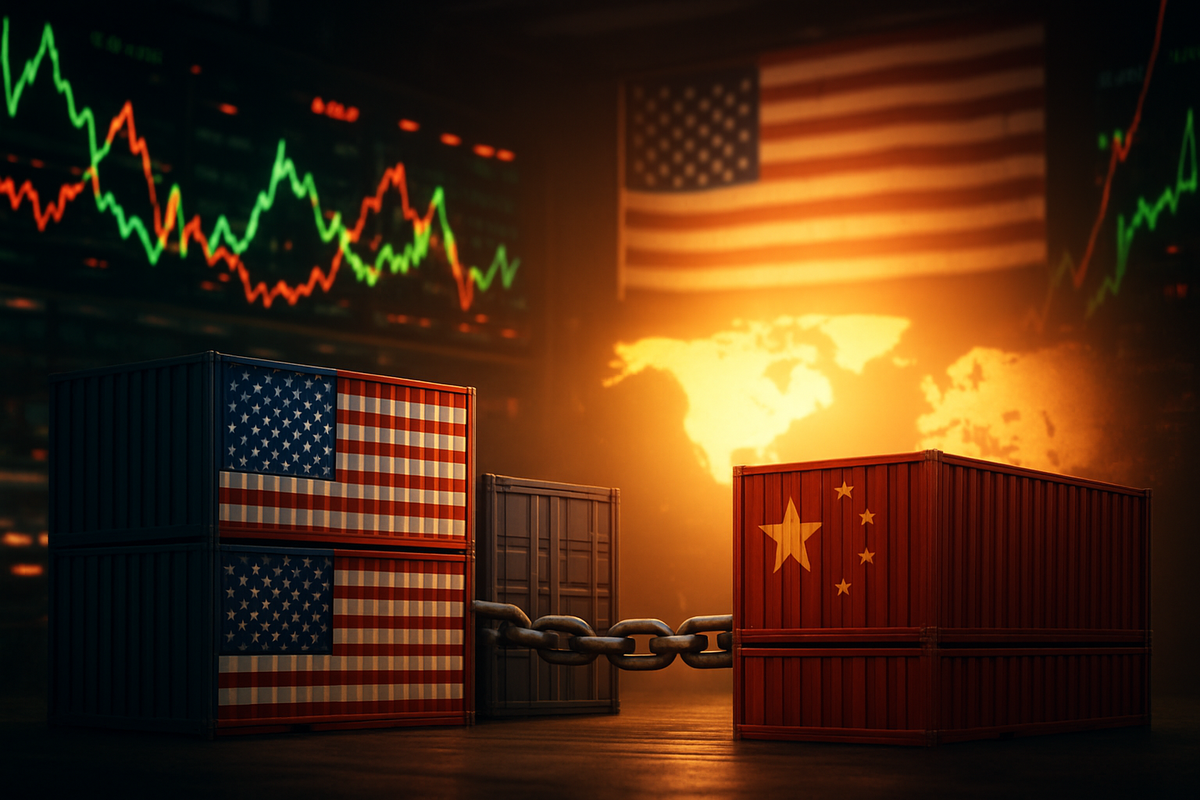
As the calendar turns to January 2, 2026, the American financial landscape is still vibrating from the seismic shifts of the past year. The year 2025 will be remembered in the history books as the era of "America First 2.0," a period where trade protectionism moved from a campaign slogan to a structural pillar of the U.S. economy. For investors, it was a year of whiplash, beginning with a "tariff shock" that briefly wiped out trillions in market value, only to end with a resilient, albeit fragmented, rally that pushed the S&P 500 to new record highs.
The immediate implications of this strategy are clear: the era of seamless globalization has officially ended. In its place is a "North American Fortress" model, where supply chains are being forcibly rerouted through domestic and regional corridors. While the broader market managed to post a total return of approximately 16% in 2025, the internal mechanics of the stock market have changed. The "K-shaped" recovery of 2025 has created a stark divide between domestic industrial titans and globalized tech giants, leaving investors to navigate a 2026 landscape where trade policy is now the primary driver of corporate earnings.
The Year of the "April Crash" and the "October Détente"
The timeline of 2025 was defined by two major pivots in trade strategy. Following his inauguration in January, President Trump moved with unprecedented speed, utilizing the International Emergency Economic Powers Act (IEEPA) to bypass traditional legislative hurdles. By March, the administration had announced a 60% baseline tariff on Chinese imports, followed in April by a 10% to 20% universal baseline tariff on nearly all trade partners. The reaction from Wall Street was swift and brutal; the S&P 500 (SPX) plummeted 19% from its February peak, an event now colloquially known as the "April Crash." Volatility spiked to levels not seen since the 2020 pandemic, as companies scrambled to assess the impact on their margins.
However, the "chaos" of the first half of 2025 gave way to a strategic "détente" in the fall. In late October, a breakthrough agreement with China saw the U.S. agree to modest tariff reductions in exchange for massive agricultural purchases—including 25 million metric tons of soybeans—and a commitment from Beijing to delay restrictions on rare earth minerals. This "Phase One-Plus" deal, combined with the passage of the One Big Beautiful Act (OBBBA)—a sweeping corporate tax incentive package—fueled a massive year-end rally. Key stakeholders, including Treasury officials and trade hawks, argued the volatility was a "necessary fever" to break America's dependence on foreign manufacturing, while the Federal Reserve remained in a "hawkish pause" for much of the year to combat tariff-induced inflation.
Winners and Losers: The Great Supply Chain Divide
The impact of these policies has been unevenly distributed across the market. The clear winners have been domestic commodity producers and manufacturers. Nucor (NYSE: NUE), the largest U.S. steelmaker, emerged as a market darling, implementing nine consecutive weeks of price hikes as foreign competition was effectively priced out of the market. Similarly, the financial sector, led by giants like Goldman Sachs (NYSE: GS) and J.P. Morgan (NYSE: JPM), benefited from the increased M&A activity as companies sought to acquire domestic competitors to bolster their U.S. footprints. Even Nvidia (NASDAQ: NVDA) managed to defy the gravity of export restrictions; despite losing billions in potential Chinese revenue, the insatiable global demand for AI chips and a late-year waiver to ship H200 chips to approved partners kept its valuation near the $4 trillion mark.
Conversely, the losers of 2025 were those most entangled in global supply chains. Apple (NASDAQ: AAPL) faced a grueling year, with its stock price finishing down nearly 10% as it struggled to pass on the costs of its China-centric assembly model to consumers. Retailers also bore the brunt of the universal baseline tariff. Target (NYSE: TGT) reported a significant plunge in EBITDA, particularly as the 25% "leverage tariffs" on Mexican imports hit its grocery and electronics margins. Caterpillar (NYSE: CAT) found itself in a "double bind," facing higher costs for raw materials like domestic steel while simultaneously being targeted by retaliatory tariffs in European and Asian markets, leading to a year of stagnating growth and missed earnings targets.
Inflation, the Fed, and the "North American Fortress"
The wider significance of the 2025 trade war lies in its impact on the Federal Reserve’s mandate. Tariff-induced price hikes pushed headline inflation toward 3% by mid-2025, forcing Jerome Powell to hold interest rates at 4.25%–4.50% despite intense political pressure to cut. This "hawkish pause" created a unique environment where the market had to price in both higher costs and higher rates. Historically, analysts have compared this period to the 1930 Smoot-Hawley Tariff Act, though with a critical caveat: today’s economy is 70% services-based, providing a buffer that the agriculture-heavy economy of the 1930s lacked.
The broader trend is the emergence of a "North American Fortress." The administration's strategy has effectively forced a decoupling from China while deepening ties with Canada and Mexico—albeit through high-pressure negotiations. This has led to a "permanent fragmentation" of global trade. The regulatory implications are profound; the use of the IEEPA to levy tariffs has triggered a constitutional debate that has now reached the highest levels of the judiciary. This shift from "rules-based" trade to "power-based" trade has forced competitors and partners alike to adopt similar protectionist measures, creating a global landscape of competing trade blocs.
The 2026 Horizon: USMCA and the Supreme Court
Looking ahead into 2026, two major events loom over the market. First is the landmark Supreme Court ruling on the constitutionality of the IEEPA-based tariffs, expected in early 2026. If the court strikes down the administration’s use of emergency powers to levy tariffs, the market could see a "tariff relief rally." However, such a ruling would also create a "fiscal cliff," as the administration would likely pivot to Section 122 of the Trade Act of 1974, which allows for temporary balance-of-payments tariffs, potentially leading to another round of market uncertainty.
The second critical event is the mandatory six-year review of the United States-Mexico-Canada Agreement (USMCA) by July 1, 2026. This is expected to be a high-stakes renegotiation rather than a procedural check. The Trump administration is expected to push for even higher "Rules of Origin" requirements for automobiles and "mirror tariffs" on Chinese EVs passing through Mexico. For investors, this means that the volatility of 2025 may not be an outlier but the "new normal." Companies that have already invested in "near-shoring" or "friend-shoring" will likely find themselves at a strategic advantage as these regional trade barriers become more entrenched.
A New Era for Investors
In summary, the trade policies of 2025 have fundamentally rewired the U.S. stock market. The "Trump Put"—the market's belief that the administration will temper its trade rhetoric if the S&P 500 falls too far—was tested in April and ultimately held firm by October. However, the price of this market floor has been structural inflation and a permanent increase in the cost of doing business globally. The key takeaway for the coming months is that the "Goldilocks" era of low inflation and seamless trade is over.
Moving forward, investors should keep a close eye on CPI data and the specific language of the upcoming USMCA review. The market in 2026 is expected to be "bullish but broadening," with major institutions like Goldman Sachs projecting the S&P 500 could reach 7,600 by year-end, provided the "tariff shocks" of the previous year continue to be absorbed. The lasting impact of 2025 will be the realization that in the 2020s, a company’s supply chain is just as important to its valuation as its product innovation. The winners of 2026 will be those who can navigate the "Fortress America" economy with agility and foresight.
This content is intended for informational purposes only and is not financial advice.