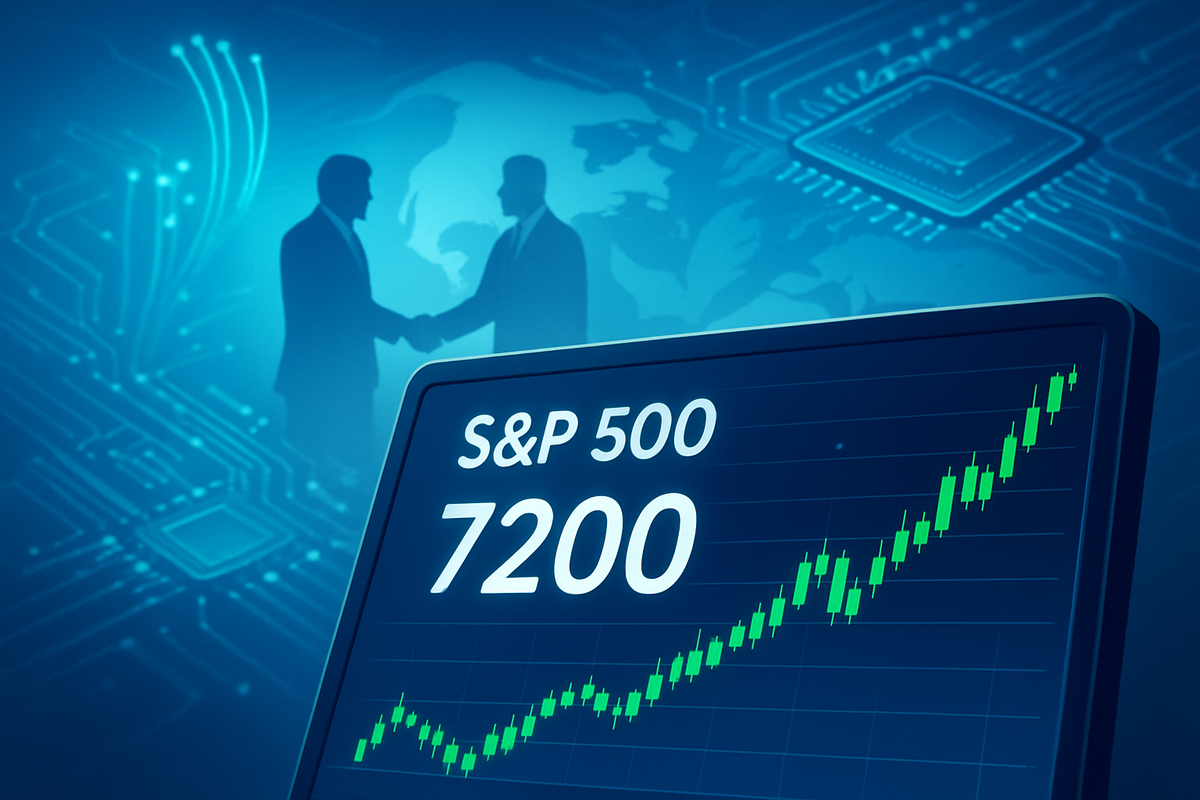
As of January 28, 2026, the U.S. financial markets are basking in a rare "risk-on" atmosphere, driven by a simultaneous easing of major international conflicts that have haunted global trade for years. With the S&P 500 (INDEXSP:.INX) breaching the 7,200 level for the first time, investors are aggressively recalibrating their portfolios to account for a significant reduction in the "equity risk premium"—the extra return investors demand for holding stocks over safe-haven assets like Treasury bonds.
The immediate implications are profound: capital is rotating out of defensive "war-hedge" positions and back into high-growth technology and global commerce sectors. This shift suggests a market belief that the "worst-case" scenarios for global contagion in the Middle East and Eastern Europe have been successfully walled off, paving the way for a more predictable, if still fragile, global economic landscape.
A Global Pivot toward Stability
The current market euphoria is the result of a series of diplomatic breakthroughs that culminated in late 2025 and the first weeks of 2026. Most notably, the transition of the conflict in Eastern Europe into a "stable ceasefire" phase following U.S.-brokered talks has removed the immediate threat of energy blackmail against Europe. Simultaneously, a formal ceasefire in the Middle East, supported by an international stabilization force, has significantly lowered the "fear premium" on global oil routes through the Strait of Hormuz.
Perhaps the most surprising catalyst for the early 2026 rally was the "Great Recalibration" of trade relations between Washington and Beijing. Following a landmark summit, the U.S. government authorized the sale of high-end AI semiconductors to Chinese hyperscalers under strict new compliance protocols. This move, exemplified by Beijing’s approval of the purchase of H200 chips from Nvidia Corp (NASDAQ: NVDA) in early January, signaled a pivot from total decoupling toward a "managed competition" model that has greatly boosted investor confidence in the semiconductor supply chain.
The reaction from institutional desks has been swift. Analysts at Morgan Stanley (NYSE: MS) and other major firms have noted that the Equity Risk Premium (ERP) has compressed to a range of 4.2% to 4.8%, a sharp decline from the 5.5% peaks seen during the heightened tensions of early 2025. This compression reflects a psychological shift among fund managers who are now more willing to accept lower yields in exchange for the perceived end of "perma-crisis" volatility.
Winners and Losers in the De-Escalated Economy
The technology sector stands as the primary beneficiary of this geopolitical thaw. Nvidia Corp (NASDAQ: NVDA) and Intel Corp (NASDAQ: INTC) have seen their valuations swell as the reopening of the Chinese market provides a massive revenue "backfill" for their data center and logic chip segments. For Intel specifically, the stabilization of global supply chains in the South China Sea has reduced the perceived risk to its foundry expansion plans, making the stock a favorite for those betting on a "normalized" global trade environment.
Conversely, the traditional energy sector is grappling with the disappearance of the "geopolitical surcharge" on crude prices. As the threat of supply disruptions in Syria and the Persian Gulf recedes, Brent crude has seen downward pressure, with forecasts projecting a drop into the $50 per barrel range. This has forced integrated giants like Exxon Mobil Corp (NYSE: XOM) and Chevron Corp (NYSE: CVX) to pivot their messaging toward efficiency and capital returns rather than growth, as the "peace dividend" lowers the floor for global energy prices.
The defense sector, while seeing some initial profit-taking, is undergoing a strategic metamorphosis rather than a total decline. Companies like Lockheed Martin Corp (NYSE: LMT) and Northrop Grumman Corp (NYSE: NOC) are trading near record highs, but not due to active conflict. Instead, the market is rewarding their transition toward "next-gen readiness." Northrop Grumman, for instance, has benefited from the ramp-up of the B-21 Raider into low-rate production and its dominance in orbital defense. Meanwhile, Palantir Technologies Inc (NYSE: PLTR) continues to win contracts for AI-enabled autonomous systems as the U.S. military shifts its focus from "active munitions" to long-term "software-driven deterrence."
Analyzing the Broader Market Significance
This compression of the risk premium fits into a broader industry trend toward "growth at a reasonable price" (GARP). In previous years, geopolitical shocks were often used as a reason to hoard cash or hide in defensive staples. In early 2026, the market has adopted what traders call the "TACO" trade (Trump-induced Action/Compliance/Outcome), where aggressive initial rhetoric is increasingly viewed as a precursor to a negotiated settlement rather than a long-term disruption. This has fundamentally changed how volatility is priced into domestic equities.
The ripple effects are felt most strongly in the relationship between the S&P 500 and the 10-year Treasury note. With the "geopolitical discount" removed, the margin of safety for stocks has become remarkably thin. Historically, when the risk premium compresses this rapidly, it signals a transition from a "fear-based" market to a "liquidity-based" market. We are seeing a precedent similar to the post-Cold War era of the 1990s, where the absence of a peer-competitor conflict allowed for prolonged P/E multiple expansion.
However, the regulatory implications of this easing cannot be ignored. While trade is reopening, the "security guardrails" remain high. The U.S. government's ability to "turn the faucet" on and off for technology exports to China remains a potent tool of statecraft. This means that while the risk premium is lower today, the "policy risk" remains a permanent fixture of the 2026 investment landscape, requiring a more nuanced approach than the simple "buy the dip" strategies of the past decade.
The Road Ahead: Potential Scenarios for 2026
In the short term, the market is likely to remain in a "Goldilocks" phase, characterized by moderating inflation and a Federal Reserve that is no longer pressured to hike rates to combat commodity-driven price shocks. The potential for a sustained period of low volatility (VIX below 15) could lead the S&P 500 toward the 7,500 mark by mid-year. However, the primary challenge for corporations will be adapting to a "lower for longer" inflation environment where pricing power may diminish as supply chains fully normalize.
Long-term, the market must prepare for the possibility of a "peace supply overhang" in sectors like energy and basic materials. If the ceasefires in Eastern Europe and the Middle East hold, the sudden re-entry of sanctioned or disrupted supply could lead to a deflationary shock in commodities. Strategic pivots toward "energy security" technology, such as the small modular reactors (SMRs) championed by NextEra Energy Inc (NYSE: NEE), will likely be the next frontier for investors seeking stability in a post-conflict global economy.
The most critical scenario to watch is the sustainability of the U.S.-China chip truce. Should diplomatic relations fray again, the "re-leveraging" of the risk premium would be violent, as the current market has effectively "priced in" a permanent reduction in trade hostilities. Investors must remain vigilant for any signs of "diplomatic fatigue" that could reverse the current rally.
Wrap-up: Navigating the De-Risked Market
The easing of geopolitical tensions in early 2026 has provided a powerful tailwind for U.S. equities, effectively removing the "dark cloud" that suppressed valuations throughout 2024 and 2025. The compression of the Equity Risk Premium represents a vote of confidence in the international order's ability to manage conflict through diplomacy and economic interdependence.
As we move forward, the market's trajectory will depend on whether this "peace dividend" can be sustained without triggering a deflationary trap in the energy sector. For investors, the takeaway is clear: the focus has shifted from "surviving the shock" to "capturing the normalization." While defense and energy stocks remain essential components of a diversified portfolio, the growth engine has firmly returned to the technology and consumer-discretionary sectors.
In the coming months, the key metrics to watch will be the S&P 500's forward P/E multiple and any shifts in the Federal Reserve's stance on interest rates. As long as the "geopolitical discount" remains absent, the market will likely continue its upward climb, but with a thin margin of safety that demands precise execution and a watchful eye on the headlines from Washington and abroad.
This content is intended for informational purposes only and is not financial advice.