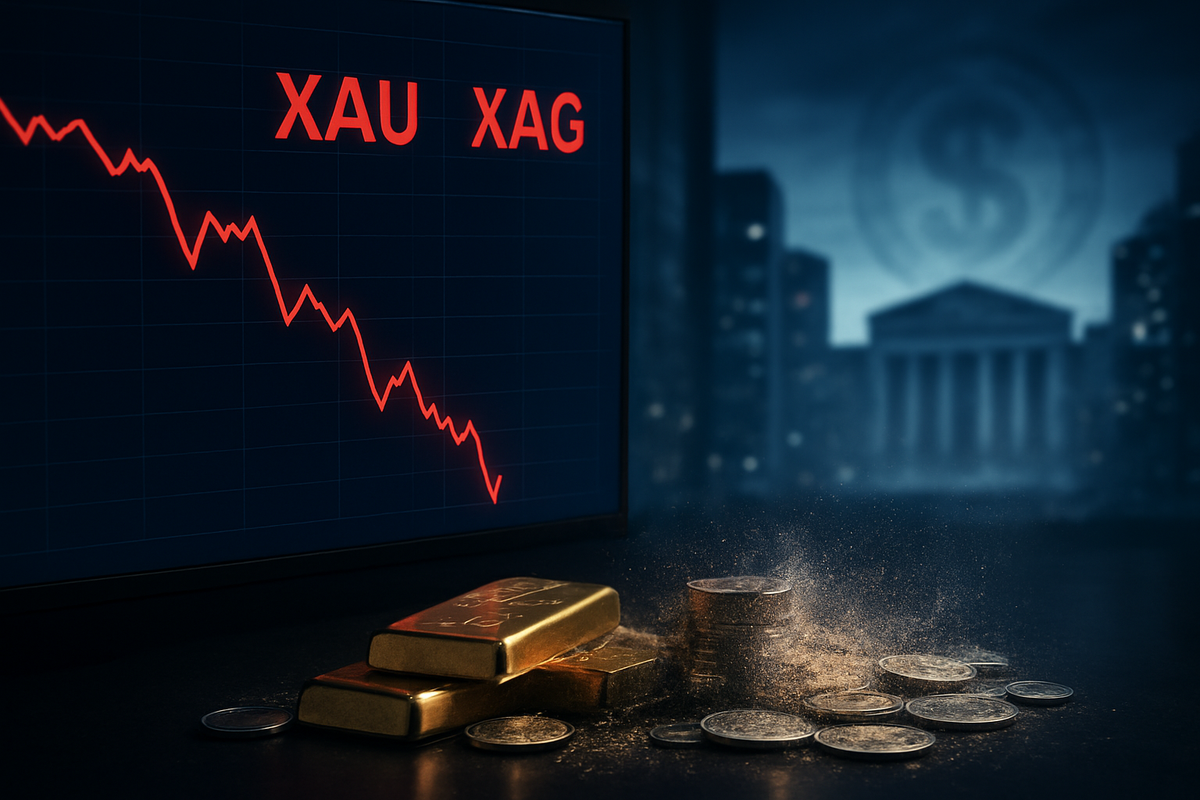
The commodities super-cycle of the mid-2020s hit a violent, brick wall this week in what traders are already calling the "Warsh Meltdown." After a multi-year rally that saw gold reach stratospheric heights, the market experienced a historic systemic liquidity rupture. Gold prices, which peaked at a staggering $5,594 per ounce in late January, plummeted to an intraday low of $4,403 by February 2, 2026—a brutal 21% correction that wiped out trillions in paper wealth in a matter of days.
The carnage was even more pronounced in the silver pits, where the "devil's metal" lived up to its volatile reputation. Silver cratered by more than 32% from its year-to-date high, falling from levels above $115 to find a tenuous floor near $71. This sudden evaporation of liquidity has sent shockwaves through the global financial system, ending the "debasement trade" that had dominated investor psychology since 2024 and forcing a massive repricing of risk across all asset classes.
The Catalyst: A Hawkish Pivot and the Death of the Debasement Trade
The primary spark for this historic collapse was the surprise nomination of Kevin Warsh to succeed Jerome Powell as Chair of the Federal Reserve. Announced by the White House on Friday, January 30, 2026, the move caught markets completely off guard. Warsh, long known for his hawkish leanings and staunch defense of the U.S. dollar’s purchasing power, represents a radical departure from the accommodative "higher for longer" but ultimately flexible stance of his predecessor. His nomination signaled a definitive end to the era of perceived monetary subordination, where investors bet that the Fed would prioritize government debt sustainability over inflation control.
Immediately following the news, the U.S. Dollar Index (DXY) underwent a violent short-squeeze, surging as capital flowed back into the greenback. This created a massive "air pocket" for precious metals. Gold had become a crowded "safe haven" trade, with many investors using it as a hedge against a "politicized Fed." When Warsh’s name was put forward, that narrative died instantly. The technical fallout was exacerbated by the CME Group, which implemented five separate margin hikes in just nine days, including a 33% increase for gold and a 36% increase for silver, triggering a cascade of forced liquidations and margin calls.
The market conditions leading up to the crash have since been identified by analysts as a classic "technical blow-off top." Gold’s Monthly Relative Strength Index (RSI) had reached an extreme reading of 90 in late January, a level historically associated with imminent reversals. As the "Warsh Shock" hit, market makers struggled to provide liquidity, leading to "flash crash" conditions where gold gapped down hundreds of dollars in single trading sessions with virtually no intervening bids.
Mining Giants Reeling as Equity Valuations Reset
The impact on mining equities has been nothing short of devastating, with major producers seeing their market caps slashed. Fresnillo (LSE: FRES) (LSE: FRES), the world’s largest primary silver producer, found itself in the eye of the storm. Already reeling from a production guidance cut issued on January 28—which lowered silver targets due to declining ore grades in its Mexican operations—the company saw its stock price decimated by the 32% drop in the underlying metal. For a company whose margins were already being squeezed by rising operational costs in Mexico, the collapse in silver prices has raised urgent questions about the viability of its 2026 dividend.
Antofagasta (LSE: ANTO) (LSE: ANTO) also suffered heavily, despite its primary focus on copper. The "Warsh Meltdown" wasn't limited to precious metals; industrial metals were swept up in the flight to cash as the stronger dollar made dollar-denominated commodities more expensive for global buyers. Antofagasta, which had seen its stock double in 2025 to reach all-time highs of GBX 4,176, saw those gains evaporate as analysts at major banks, including Deutsche Bank, issued swift downgrades. The "scarcity value" that had supported its high valuation disappeared overnight as investors pivoted from growth-at-any-price to capital preservation.
Other industry heavyweights were not spared. Newmont (NYSE: NEM) (NYSE: NEM) and Barrick Gold (NYSE: GOLD) (NYSE: GOLD) both saw double-digit percentage drops as the massive institutional rotation out of the "inflation hedge" sector took hold. For these companies, the sudden drop in the spot price of gold means that high-cost mines that were profitable at $5,000 per ounce are now facing the prospect of being placed on care and maintenance if prices do not recover quickly. The leverage that provided such high returns on the way up has now become a double-edged sword for the entire mining sector.
A Wider Significance: The Return of Real Rates
This event marks a significant turning point in the global macroeconomic landscape. For the past two years, the prevailing market trend was "the debasement of everything," where assets with finite supply—gold, silver, and even Bitcoin—were bid up on the assumption that central banks would never truly tighten again. The nomination of Kevin Warsh has shattered that consensus, reintroducing the concept of "positive real rates" and a Fed that is willing to defend the currency at the expense of asset prices. This fits into a broader industry trend of returning to "hard money" fundamentals after years of speculative excess.
The ripple effects are extending far beyond mining. Competitors in the luxury goods and electronics sectors, which are major consumers of gold and silver, may see a short-term boost in margins as their input costs fall, but this is likely to be offset by the broader deflationary pressure the meltdown has introduced. Historically, crashes of this magnitude—such as the 2011 silver peak or the 2013 gold drop—often lead to years of consolidation. This "systemic liquidity rupture" may serve as the catalyst for a much-needed cooling of the global economy, potentially averting a more catastrophic hyperinflationary scenario but at the cost of immediate market stability.
Regulatory and policy implications are also looming. The speed of the "flash crash" and the role of mechanical margin hikes have already drawn the attention of the Commodity Futures Trading Commission (CFTC). There are growing calls for a review of how margin requirements are adjusted during periods of high volatility to prevent the kind of "mechanical failure" seen this week, where the very mechanisms meant to protect the market ended up accelerating its demise.
What Comes Next: Navigating the New Hard-Money Regime
In the short term, the market is looking for a period of stabilization. Many analysts believe the $4,403 level in gold may hold as a temporary floor, but a return to the $5,000+ heights is unlikely until the "Warsh Fed" clarifies its roadmap for the balance sheet. Mining companies will likely be forced into strategic pivots, focusing on "high-grade, low-cost" assets and potentially pausing expansion projects that were greenlit during the peak of the mania. This could lead to a wave of consolidation in the sector, as cash-rich majors look to acquire beaten-down juniors at a fraction of their January valuations.
Strategic adaptations will be required for investors who have spent years positioned for a weak dollar. The emergence of a "strong dollar, high real rate" environment challenges the traditional 60/40 portfolio and the "all-weather" strategies that leaned heavily on gold as a stabilizer. Market opportunities may emerge in the form of oversold mining stocks, but only for those with the stomach for extreme volatility and a long-term horizon. The primary challenge will be navigating the transition from a speculative bubble to a fundamental-driven market.
Final Reflections on the 2026 Meltdown
The "Warsh Meltdown" of February 2026 will go down in financial history as one of the most rapid destructions of value in the commodities market. The key takeaway for investors is the reminder that no asset is immune to the laws of gravity, especially when fueled by excessive leverage and a one-sided narrative. The sudden shift in Federal Reserve leadership proved that the "central bank put" has its limits, and the credibility of the U.S. dollar remains the ultimate arbiter of global asset prices.
Moving forward, the market will likely be characterized by a more sober, data-dependent approach. The "safety" of gold has been called into question, and the volatility of silver has once again served as a warning to retail speculators. Investors should watch closely for Kevin Warsh's confirmation hearings in the coming months, as any further hawkish rhetoric could provide a second leg down for metals, or conversely, any sign of softening could spark a relief rally. For now, the "Golden Age" of the 2020s has been replaced by a "Hard Reality," and the scars of this week's meltdown will likely influence market behavior for years to come.
This content is intended for informational purposes only and is not financial advice.