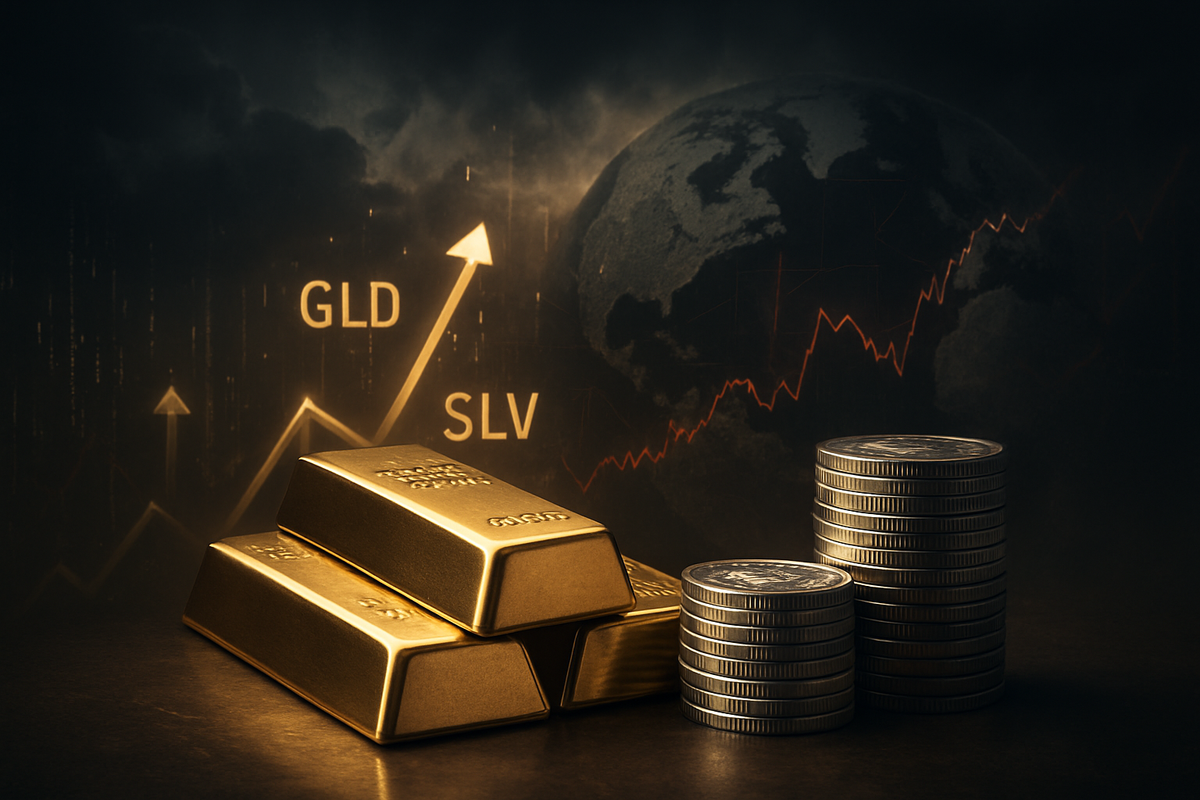
As of February 6, 2026, the financial world is witnessing a tectonic shift in capital allocation as investors desert traditional equities and bonds in favor of the millennia-old security of precious metals. This "stampede" into exchange-traded funds (ETFs) has reached a fever pitch, with the SPDR Gold Trust (NYSE Arca: GLD) and the iShares Silver Trust (NYSE Arca: SLV) becoming the primary conduits for a massive migration of wealth. Driven by a volatile cocktail of geopolitical instability and systemic banking fears, the precious metals market has effectively decoupled from the broader tech-heavy indices that dominated the previous decade.
The scale of this move is reflected in staggering performance metrics: GLD has rallied roughly 95% over the past twelve months, a climb that has seen spot gold prices breach the once-unthinkable $5,000 per ounce barrier. Meanwhile, silver has staged an even more dramatic, if volatile, ascent. SLV recently traded near record highs of $120 per ounce—levels not seen in inflation-adjusted terms since the late 1970s—before a late-January "flash crash" tested the resolve of new market entrants. This surge is not merely a retail phenomenon; it represents a deep structural reallocation by private wealth offices and institutional desks seeking a "debasement hedge" against a crumbling global fiscal order.
A Perfect Storm: Tracking the 2025-2026 Bull Run
The current frenzy in precious metals began in earnest during the latter half of 2025, sparked by the emergence of "zombie banks" in East Asia. As Chinese property-related debt reached a breaking point, billions in private capital began leaking out of the region, seeking the anonymity and safety of gold and silver. By the time 2026 opened, the crisis had migrated west, as concerns over the U.S. federal deficit and a looming government shutdown in Washington D.C. created a vacuum of confidence in the U.S. dollar. The dollar's slide to a four-year low in January acted as the final accelerant for the gold and silver rally.
The timeline reached a crescendo in late January 2026. GLD saw a record $2.6 billion in net inflows in a single month as gold spot prices peaked near $5,600. The situation in silver was even more extreme; SLV prices went "parabolic," nearly tripling in value over a four-month span. This led to a historic speculative peak on January 30, where silver suffered a 26% single-day correction—a "Black Friday" for silver bugs—driven by profit-taking and margin calls. Despite this volatility, the underlying demand remains robust, with the "dip" being aggressively bought by institutional players who view any retreat as a final entry point before further currency devaluation.
Key stakeholders, including central banks and the newly appointed leadership at the Federal Reserve, have watched the rally with growing concern. The transition of power at the Fed, following the nomination of Kevin Warsh, has injected fresh uncertainty into the market. While some saw the move as a return to fiscal discipline, others interpreted the resulting market turbulence as a sign that the "Fed Put"—the long-standing belief that the central bank will always bail out markets—has finally expired, leaving gold as the only remaining lender of last resort.
Mining Titans and the Leverage Game: Who Stands to Gain?
While ETFs provide direct exposure to the metal, the real "beta" has been found in the major mining corporations. Barrick Gold Corp (NYSE: GOLD) and Newmont Corporation (NYSE: NEM) have seen their share prices outpace the underlying metals due to the immense operating leverage of their businesses. Over the past year, Barrick Gold (GOLD) has surged approximately 176%, while Newmont (NEM) has followed closely with a 160% gain. For these companies, a $5,000 gold price represents a windfall of historic proportions, as their All-In Sustaining Costs (AISC) have largely remained stable between $1,500 and $1,800 per ounce.
The massive profit margins have allowed these industry leaders to clean up their balance sheets and return record capital to shareholders through dividends and buybacks. Newmont (NEM), in particular, has benefited from its Ahafo North site in Ghana, which hit full commercial production just as prices began their vertical ascent. However, the winners are not limited to the miners. Commodity-focused hedge funds and "hard money" asset managers have seen their Assets Under Management (AUM) swell. Conversely, the "losers" in this environment are traditional growth-heavy portfolios and consumer discretionary companies that are struggling to pass on the rising costs of raw materials to a public increasingly focused on preserving purchasing power.
Traditional banking institutions that were caught short on silver during the January run-up have also faced significant headwinds. Reports of massive "short squeeze" losses among bullion banks have circulated on Wall Street, leading to a tightening of credit and further fueling the move toward physical or ETF-backed metal ownership. As liquidity dries up in the paper markets, the premium for physical delivery has reached levels that further incentivize the move into transparent vehicles like GLD and SLV.
A Historical Echo: Global Instability and the Return of Sound Money
The 2026 precious metals stampede bears a striking resemblance to the monetary crises of 1979 and even the Civil War-era volatility of 1864. This event fits into a broader industry trend of "de-dollarization," where sovereign nations and private individuals alike are diversifying away from fiat currencies that are increasingly perceived as being weaponized or mismanaged. The surge in silver, which briefly hit levels roughly triple its 2025 lows, echoes the speculative fever of the Hunt Brothers era, though this time the driver is systemic fragility rather than individual cornering of the market.
Regulatory bodies are now scrambling to keep pace with the volatility. There is growing talk in Washington about increasing margin requirements for precious metals futures to cool the "speculative heat," yet such moves often have the opposite effect, driving more investors into the spot market and ETFs. The precedent set by this rally suggests a permanent shift in the "60/40" portfolio model, with gold and silver potentially becoming permanent, high-weight fixtures in conservative asset allocations rather than mere tactical hedges.
Furthermore, the ripple effects are being felt across the green energy sector. As silver is a critical component in photovoltaic cells and electric vehicle electronics, the "record highs" in SLV are beginning to threaten the feasibility of global decarbonization targets. This creates a policy paradox: the same economic instability driving investors to silver as a safe haven is simultaneously making the transition to a sustainable economy prohibitively expensive.
The Road Ahead: Stabilization or a New Supercycle?
In the short term, the market is expected to remain in a state of high-tension consolidation. The massive "flash crash" in silver at the end of January suggests that the "easy money" has been made, and the market is now entering a phase where fundamental analysis and geopolitical developments will dictate the next leg. If the U.S. government manages to navigate its current fiscal hurdles without a prolonged shutdown or default, some of the "panic bid" may exit GLD. However, if the "zombie bank" contagion continues to spread globally, the $8,500 gold target set by some JPMorgan analysts may shift from a radical forecast to a baseline reality.
Strategic pivots will be required for both investors and companies. Mining companies like Newmont (NEM) and Barrick (GOLD) will likely face pressure to accelerate exploration and M&A activity to replace reserves that are being depleted at high-margin rates. For the average investor, the challenge will be navigating the volatility; while the long-term trend appears bullish, the "stampede" into ETFs can create liquidity traps where rapid exits become difficult during periods of extreme price swings.
The potential scenarios for late 2026 range from a return to "normalized" price discovery to a full-blown monetary reset. Should the Federal Reserve successfully anchor inflation and restore faith in the dollar, we may see a multi-year cooling of the gold rally. Conversely, many macro-economists argue that we have entered a "commodity supercycle" that will last for the remainder of the decade, as the supply of physical metal fails to meet the surging demand for safe-haven assets and industrial applications.
Summary and Investor Outlook
The massive inflows into GLD and SLV observed in early 2026 mark a historic turning point for global markets. With gold rallying 95% in a year and silver touching $120, the traditional hierarchy of assets has been upended. The primary takeaways are clear: global economic instability and a lack of faith in fiat currencies have driven a structural shift toward precious metals. While the "Black Friday" silver crash served as a reminder of the risks of speculative mania, the fundamental demand from private and institutional investors remains at all-time highs.
Moving forward, the market will likely be characterized by heightened volatility and a closer scrutiny of central bank policies. Investors should closely watch for shifts in the U.S. dollar index and any further signs of banking instability in Asia or Europe. The "stampede" may have slowed for a moment of reflection, but the underlying drivers of this rally—debt, debasement, and distrust—show no signs of vanishing. For those holding GLD, SLV, or the shares of giants like Barrick (GOLD) and Newmont (NEM), the coming months will be a test of whether this is a temporary peak or the beginning of a new era for gold and silver.
This content is intended for informational purposes only and is not financial advice.