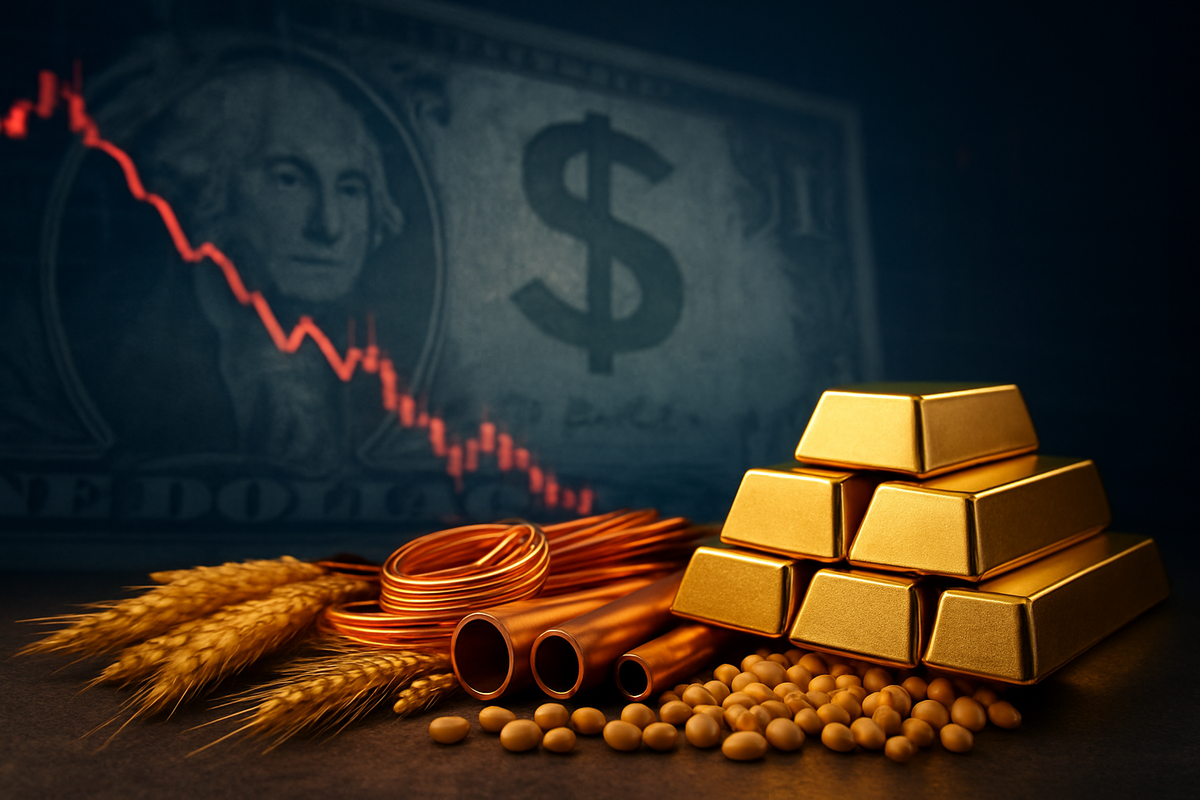
The global financial landscape has shifted dramatically as the first quarter of 2026 draws to a close. After years of relentless strength that pressured global trade and emerging markets, the U.S. Dollar Index (DXY) has finally begun a sustained retreat, falling from its 2025 peaks to stabilize in the 97.0 to 98.0 range this March. This weakening of the world’s primary reserve currency has acted as a powerful "monetary floor," halting the freefall in commodity prices and sparking a significant rally across the energy, agricultural, and precious metals sectors.
For investors and global consumers, the implications are immediate and profound. As the dollar eases, dollar-denominated assets—ranging from bushels of wheat to ounces of gold—have become more affordable for international buyers, effectively stimulating global demand. This shift has not only reversed the multi-year "grains glut" narrative but has also catapulted gold and industrial metals into a new era of price discovery, driven by a combination of a weaker greenback and structural supply constraints.
A Strategic Pivot: The Fed, Geopolitics, and the DXY
The current easing of the U.S. dollar is the culmination of a pivotal shift in Federal Reserve policy that began in late 2025. Following a period of restrictive interest rates, the Fed, led by Chair Jerome Powell, implemented three consecutive 25-basis-point cuts between September and December 2025, bringing the federal funds rate to a target range of 3.50% to 3.75%. This move narrowed the "yield advantage" that had previously made the dollar an irresistible destination for global capital. While the Fed paused its cutting cycle at the January 28, 2026 meeting, the market remains convinced that the broader trend is toward further easing, keeping the dollar under pressure.
The timeline leading to this moment was further complicated by a "safe-haven" spike in early March 2026. Following geopolitical escalations in the Middle East, including disruptions near the Strait of Hormuz, the DXY briefly bounced toward 98.0 from a four-year low of 95.5 set in January. However, this recovery proved short-lived as structural concerns over the U.S. fiscal deficit—projected to exceed 7% of GDP in 2026—and moderating U.S. GDP growth of 1.8% began to weigh more heavily on the currency.
Market reactions have been swift. The International Grains Council (IGC) Grains and Oilseeds Index (GOI) surged by 4% in late February and early March, fully erasing the losses seen in the final months of 2025. Wheat and soybeans have led the charge, with export prices firming as international buyers rush to lock in contracts at lower dollar-equivalent prices. This resurgence in the grains sector signals a departure from the "lower-for-longer" price environment that dominated 2024 and 2025.
Winners and Losers in the Commodity Super-Cycle
The primary beneficiaries of this currency shift have been the heavyweights of the mining and precious metals sectors. Newmont Corporation (NYSE: NEM), the world's largest gold producer, has seen its revenue projections swell alongside the historic gold rally. With gold hitting an all-time high of $5,595/oz in late January before settling into its current $5,120–$5,300 range, Newmont’s leverage to bullion prices has been a major tailwind. Analysts estimate that every $100/oz increase in the price of gold adds approximately $505 million to the company’s pre-tax revenue, positioning it as a cornerstone for institutional investors seeking protection against dollar debasement.
Similarly, Freeport-McMoRan (NYSE: FCX) has capitalized on the dollar's weakness to offset operational challenges. While the company faced supply constraints due to the Grasberg mine maintenance in late 2025, the surge in copper prices to record highs of $14,500 per metric ton ($6.58/lb) in January 2026 has bolstered its balance sheet. The weak dollar has made its copper exports significantly more competitive in Asian markets, particularly in China, where demand for AI-driven infrastructure and electrification continues to outstrip available supply.
Conversely, the agricultural giants face a more complex reality. While the dollar easing theoretically helps exporters like Archer-Daniels-Midland (NYSE: ADM) and Bunge Global SA (NYSE: BG) by making U.S. crops cheaper, they are currently navigating a minefield of trade policy. High tariffs on Chinese goods and a global grain surplus have pressured margins despite the currency advantage. Bunge, in particular, has seen its 2026 profit outlook dampened by macro uncertainty, as some customers remain hesitant to enter long-term supply agreements amidst the volatile trade environment.
Historical Parallels and the New Macro Reality
The current relationship between the dollar and the IGC Grains and Oilseeds Index echoes the famous "Farm Boom" of the 1970s. During that era, a 30% depreciation of the U.S. dollar fueled record-breaking agricultural exports, transforming the Midwest economy. While 2026 has not yet seen a depreciation of that magnitude, the inverse correlation remains intact: historically, a 1% decline in the dollar index correlates with a roughly 0.5% increase in the value of agricultural exports. This "monetary lift" is providing a floor for commodities that otherwise might have continued to struggle under the weight of high production levels.
Furthermore, the 2026 commodity surge draws comparisons to the "Supercycle" of 2002–2008. Much like that period, the current market is being driven by a multi-year dollar decline combined with structural demand—though today, that demand is fueled by AI data centers and the global energy transition rather than China’s urbanization. The "triple breakout" of gold, silver, and copper in early 2026 represents the first time these metals have hit simultaneous records since 1980, marking a potential "epochal shift" in how commodities are valued relative to fiat currencies.
Policy implications are also looming large. As the dollar eases and commodity-driven inflation begins to tick up, the Federal Reserve faces a "double-edged sword." While a weaker dollar helps exporters and eases the debt burden for emerging markets, it also risks re-igniting domestic inflation through higher import costs. This tension is likely to dominate the discourse as the search for a new Fed Chair begins in May 2026, with the market watching closely to see if the next leader will prioritize currency stability or continued monetary easing.
The Road Ahead: Scenarios for the Rest of 2026
In the short term, market participants should expect continued volatility as the "Iran shock" continues to filter through risk-parity models. However, the underlying trend for the dollar remains biased toward the downside as the U.S. yield advantage evaporates. Two additional 25-basis-point rate cuts are widely expected by the end of 2026, likely starting in July, which could push the DXY toward the low-90s. If this occurs, we could see another leg up in the commodity rally, with $6,000/oz gold and $7.00/lb copper no longer appearing out of reach.
Strategically, multinational corporations are already pivoting their hedging strategies. Companies that were once desperate for "dollar-strength protection" are now shifting focus toward hedging against a potential "commodity-cost squeeze." This transition will require significant adaptation in the consumer staples and industrial sectors, where rising input costs for grains and metals could squeeze margins if they are unable to pass those costs onto consumers who are already feeling the pinch of a cooling economy.
Market Wrap-Up: A New Floor in Place
The easing of the U.S. dollar in early 2026 has fundamentally rebased the commodity markets. By providing a broad-based floor for prices, the weaker greenback has ended the "deflationary chill" that had gripped the grains and metals sectors for much of 2025. The IGC Grains and Oilseeds Index has found its footing, and the record highs in gold and copper underscore a growing investor preference for tangible assets in an era of fiscal expansion and currency uncertainty.
Moving forward, the market’s trajectory will be defined by the "hand-off" from Federal Reserve policy to geopolitical realities. Investors should keep a close watch on the upcoming May appointment of the next Fed Chair and the potential for a "tariff-induced" inflation spike that could force a sudden reversal in dollar sentiment. For now, however, the "Greenback Retreat" remains the dominant narrative, providing a much-needed tailwind for global producers and a new set of challenges for policymakers.
This content is intended for informational purposes only and is not financial advice.