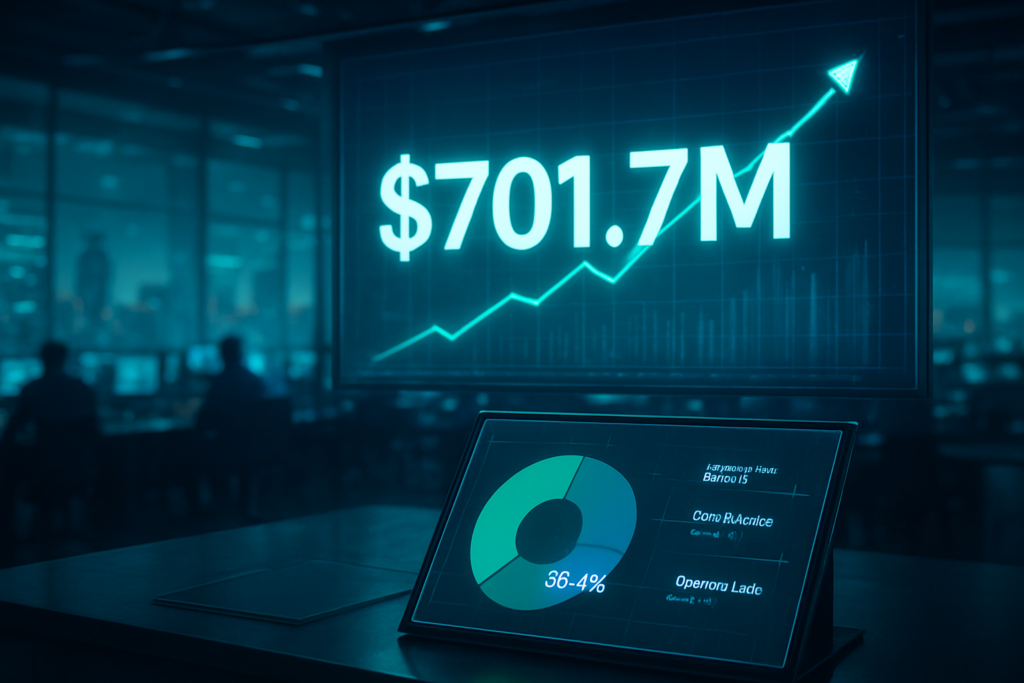
The prediction market industry reached a historic milestone on January 12, 2026, as total daily trading volume across major platforms surged to a staggering $701.7 million. This record-breaking figure represents the highest single-day turnover in the history of the sector, signaling the definitive arrival of event-based trading as a cornerstone of modern finance. At the heart of this surge was Kalshi, which commanded a massive 66.4% of the market share, processing approximately $466 million in trades within a single 24-hour window.
The explosion in volume comes as traders increasingly pivot away from traditional sentiment indicators and toward the high-stakes "truth engine" of the prediction markets. The flurry of activity on January 12 was driven by a confluence of high-impact events, including critical macroeconomic data releases and early-cycle positioning for the 2026 U.S. Midterm elections. For an industry that was once relegated to the fringes of the crypto world, this $700 million day serves as a powerful validation of its growing utility and liquidity.
The Market: What’s Being Predicted
The record-breaking volume of $701.7 million was distributed across a handful of key players, with Kalshi leading the pack by a wide margin. Following behind were Polymarket and the rapidly ascending Opinion Labs (operating as Opinion.trade). While sports and pop culture remain popular, the bulk of the record day’s volume was concentrated in "hard" markets: Federal Reserve interest rate decisions, quarterly GDP prints, and the first major polls of the 2026 election cycle.
The liquidity on these platforms has reached a point where institutional-sized positions can be entered and exited with minimal slippage. On Kalshi, the "Will the Fed cut rates in March?" contract saw over $120 million in volume alone, with odds fluctuating wildly as new labor data hit the wires. These contracts are legally structured as derivatives, providing a regulated framework that has attracted a new class of professional arbitrageurs and hedge funds.
Resolution criteria for these markets remain strictly objective. Most high-volume contracts on Kalshi and Opinion rely on government data or verified SEC filings to determine outcomes. This transparency has been critical in building trust among retail investors, many of whom have moved their speculative capital from volatile memecoins to the more "knowable" outcomes of the prediction markets.
Why Traders Are Betting
The momentum leading into the January 12 record was built throughout a transformative 2025. Last year, Kalshi secured its position as the market leader through a series of strategic integrations, most notably with Robinhood Markets, Inc. (NASDAQ: HOOD). This partnership allowed millions of retail traders to access event contracts directly from their primary brokerage accounts, effectively democratizing access to "skin in the game" forecasting.
Furthermore, the legal landscape shifted dramatically in favor of the industry. Following Kalshi's landmark legal victories against the CFTC in 2024 and 2025, the uncertainty surrounding the legality of election and macro-event trading evaporated. This clarity encouraged massive "whale" activity; on January 12, several eight-figure positions were spotted in the 2026 Congressional control markets, as traders sought to hedge against potential policy shifts.
Traditional forecasting methods, such as political polling and analyst reports, have also seen their influence wane in favor of these markets. Traders are increasingly betting that the financial incentives of a prediction market produce more accurate "signals" than a standard poll. This "wisdom of the crowd" was on full display as the markets correctly anticipated a series of hawkish comments from central bank officials hours before they were delivered, a move that contributed to the day's record-breaking volatility.
Broader Context and Implications
The January 12 surge is part of a broader trend that saw global prediction market volume grow from $9 billion in 2024 to over $44 billion by the end of 2025. This rapid scaling has drawn the attention of traditional financial giants. Intercontinental Exchange (NYSE: ICE), the parent company of the New York Stock Exchange, recently made a significant investment in the infrastructure powering these platforms, recognizing that event contracts are becoming a legitimate asset class.
However, the rise of these markets has not been without controversy. While federal regulators have largely stepped back, state-level opposition is growing. In late 2025, New York introduced the ORACLE Act, a legislative attempt to curb sports and political betting on prediction platforms. Traders are watching these developments closely, as a potential Supreme Court case looms that could decide whether these markets are federally protected derivatives or state-regulated gambling.
Historically, prediction markets have proven remarkably accurate, often outperforming professional pundits during the 2024 election and subsequent economic pivots. This track record has transformed them into a vital tool for corporate risk management. Companies now use these markets to hedge against specific regulatory outcomes or geopolitical shifts, treating a "No" vote on a specific piece of legislation with the same financial seriousness as a currency hedge.
What to Watch Next
As the industry digests the $701.7 million milestone, all eyes are on the upcoming 2026 Midterm election cycle. Analysts project that if current trends hold, single-day volumes could exceed $1 billion by November. The entry of CME Group Inc. (NASDAQ: CME) and Interactive Brokers Group, Inc. (NASDAQ: IBKR) into the event contract space is expected to further institutionalize the market, bringing even more liquidity to high-stakes contracts.
Key dates to monitor include the upcoming February inflation report and the formal launch of several new "Opinion" markets focused on emerging technology milestones, such as AI safety certifications. These "tech-native" markets are expected to attract a younger demographic of traders who are more interested in the future of Silicon Valley than the halls of Washington.
The evolution of the "Opinion" platform will also be a major narrative in 2026. By focusing on real-economy indicators and using AI-powered oracles for resolution, Opinion Labs is positioning itself as a high-tech alternative to the more established players. Whether it can continue to eat into Kalshi’s 66% market share remains the biggest question for the year ahead.
Bottom Line
The $701.7 million day of January 12, 2026, is more than just a statistical anomaly; it is a signal that prediction markets have reached a state of maturity. Kalshi’s dominant 66.4% share highlights the value that traders place on a regulated, liquid, and user-friendly interface. With the backing of major financial institutions and a growing track record of accuracy, these platforms are no longer just for "betting"—they are for "knowing."
As we move deeper into 2026, the intersection of finance, data, and public sentiment will only become more integrated. Prediction markets provide a unique window into the collective mind of the global investor, offering a real-time, financially-backed truth that traditional media and polls simply cannot match. For those looking to understand where the world is headed, the odds on the board are now as important as the news on the screen.
This article is for informational purposes only and does not constitute financial or betting advice. Prediction market participation may be subject to legal restrictions in your jurisdiction.
PredictStreet focuses on covering the latest developments in prediction markets.
Visit the PredictStreet website at https://www.predictstreet.ai/.