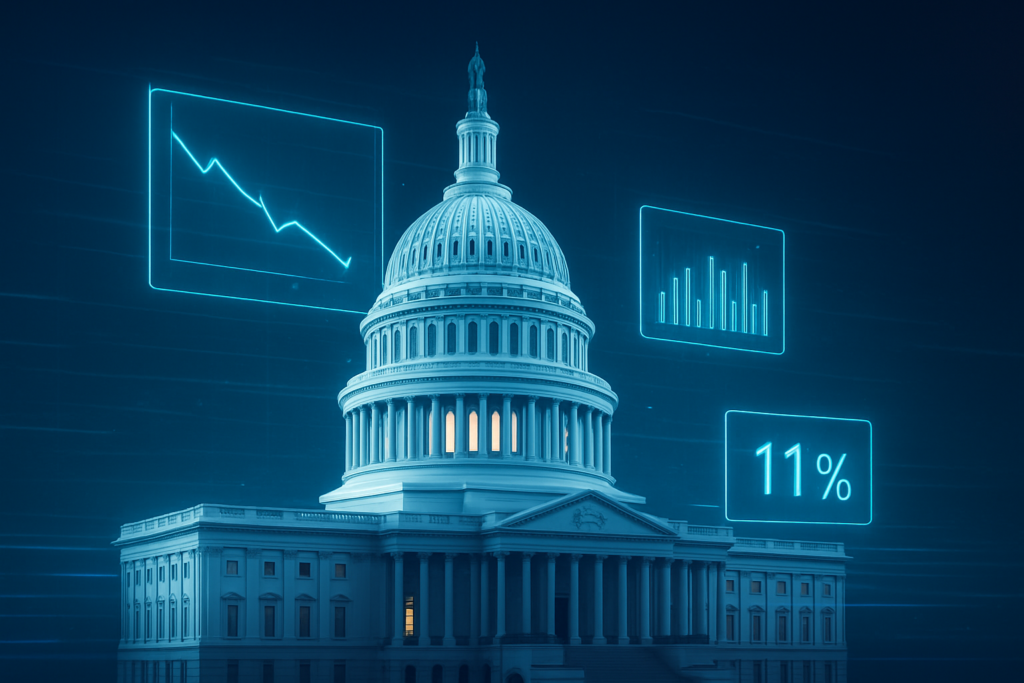
As the January 31 deadline for federal funding rapidly approaches, the high-stakes political drama usually associated with Capitol Hill budget battles appears to be fizzling out—at least according to the collective intelligence of the world’s most active traders. On the leading decentralized prediction platform Polymarket, the probability of a U.S. government shutdown has plummeted to just 11%, a stark contrast to the coin-flip odds seen just months ago.
This low-probability signal comes despite the looming expiration of several funding measures, suggesting that the "shutdown fatigue" following 2025’s record-breaking 43-day funding lapse has fundamentally altered the legislative landscape. With over $3 million in trading volume on this specific outcome, the market isn't just guessing; it is pricing in a high degree of confidence that a deal is already effectively done.
The Market: What's Being Predicted
The primary theater for this financial forecasting is Polymarket, where the contract "Will there be another US government shutdown by January 31?" has become a focal point for political speculators. Currently, the "Yes" shares are trading at approximately 11 cents, implying an 11% chance of a funding lapse. This represents a significant collapse in odds from late December, when the same contract touched 45% amid fears of a renewed partisan deadlock.
Parallel activity is occurring on the U.S.-regulated exchange Kalshi, which has seen even higher engagement levels. Kalshi’s shutdown market has recorded over 1.66 million transactions, with a massive liquidity pool of more than 28 million contracts. While Kalshi’s implied probability sat slightly higher at 24% earlier in the month, live order book activity has rapidly converged with Polymarket’s sub-15% levels as news of legislative progress reached the floor.
The resolution criteria for these markets are strict: a shutdown is typically defined as a lapse in appropriations that results in the issuance of "furlough notices" to federal employees. With the clock ticking toward midnight on January 30, the narrow window for failure is what's driving the current 11% floor, as any minor procedural hiccup in the Senate could still theoretically trigger a weekend lapse.
Why Traders Are Betting
The overwhelming sentiment for a "No" resolution is rooted in the unique political composition of early 2026. Following the 2024 elections, Republicans maintain control of the White House, the House of Representatives, and the Senate. This unified government has streamlined the appropriations process, moving away from the chaotic "continuing resolution" (CR) cycles of the previous year.
Traders are specifically reacting to the passage of two massive funding bills. On January 22, the House passed H.R. 7148, the Consolidated Appropriations Act of 2026, with a bipartisan 341–88 vote. This followed the enactment of the "One Big Beautiful Bill" (OBBB) Act late last year, which pre-funded nearly 90% of federal operations. Markets are also closely monitoring the influence of the Department of Government Efficiency (DOGE), whose cost-cutting recommendations have provided fiscal hawks with enough "wins" to support the broader spending packages without resorting to shutdown tactics.
Furthermore, the memory of the 43-day shutdown in late 2025—the longest in American history—acts as a powerful deterrent. That event caused significant volatility for major defense contractors like Lockheed Martin (NYSE: LMT) and Northrop Grumman (NYSE: NOC), and traders believe leadership is desperate to avoid a repeat that could spook the broader markets or the SPDR S&P 500 ETF Trust (NYSE Arca: SPY).
Broader Context and Implications
The divergence between traditional media narratives and prediction markets has never been clearer. While some cable news outlets continue to highlight the "looming deadline" and "partisan friction," prediction markets have been steadily pricing in a resolution for over two weeks. This suggests that these platforms are increasingly serving as a "truth machine," filtering out political posturing to focus on the mechanical realities of bill drafting and vote counts.
Real-world implications of these odds are significant. A low shutdown probability allows federal agencies and private sector partners to maintain normal operations without the costly preparation for a work stoppage. Historically, prediction markets have been remarkably accurate in forecasting budget resolutions, often moving ahead of official announcements from leadership.
From a regulatory perspective, the high volume on these markets—now totaling millions across platforms—underscores the growing appetite for "event hedging." For institutional investors, these markets are no longer just a curiosity; they are a vital tool for managing the political risk associated with government contracts and Treasury yields.
What to Watch Next
The final hurdle remains the U.S. Senate. While the House has cleared the necessary legislation, the market will be watching for any "poison pill" amendments or filibuster threats that could delay the final vote past the January 30 deadline. Traders should monitor the Senate floor schedule on January 28 and 29; if a "cloture" vote is successfully called, the 11% probability will likely crash toward zero.
Another factor to watch is the specific language regarding the Department of Homeland Security funding (H.R. 7147). This remains the most contentious piece of the puzzle. If the Senate decides to split this bill from the broader "minibus" package, we could see a "partial shutdown" scenario, which might still trigger a "Yes" resolution depending on the specific wording of the Polymarket and Kalshi contracts.
Bottom Line
The 11% probability of a government shutdown on January 31 is a testament to the current era of unified government and a collective desire to avoid the economic scars of 2025. With $3 million in volume backing this sentiment on Polymarket, the "smart money" is clearly betting that the era of the frequent "shutdown cliff" is, at least for now, in the rearview mirror.
As a tool for public insight, these markets suggest that despite the loud rhetoric often found in Washington, the underlying legislative machinery is functioning with surprising efficiency. For those holding "No" positions, the next few days will be about watching the Senate clock. For everyone else, it’s a sign that the federal government is likely to stay open for business through the remainder of the fiscal year.
This article is for informational purposes only and does not constitute financial or betting advice. Prediction market participation may be subject to legal restrictions in your jurisdiction.
PredictStreet focuses on covering the latest developments in prediction markets. Visit the PredictStreet website at https://www.predictstreet.ai/.