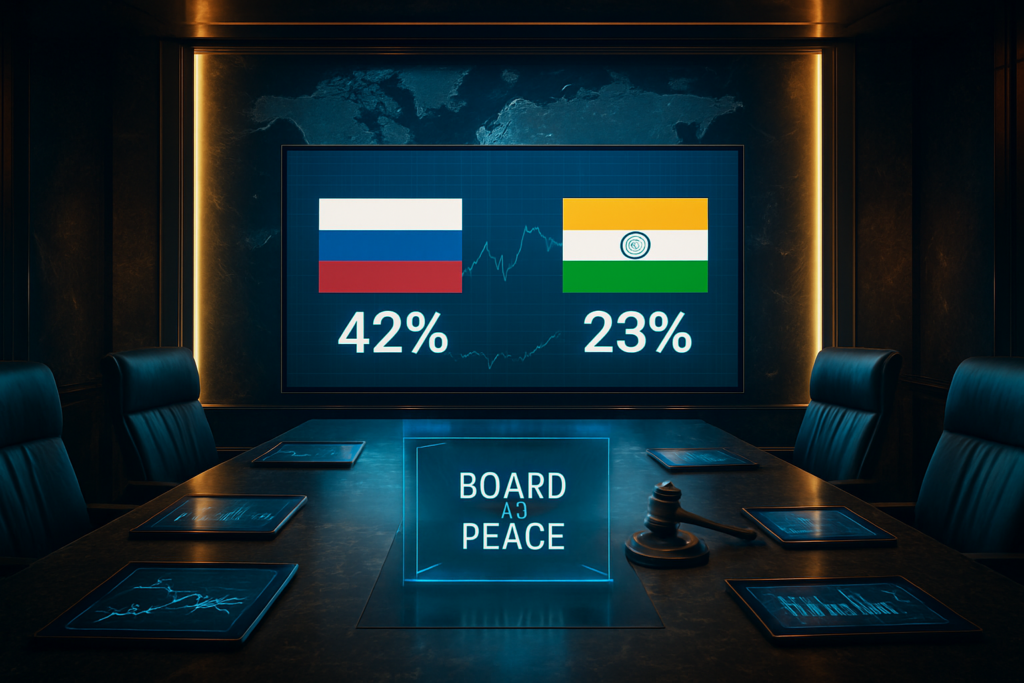
With the March 31 resolution date fast approaching, traders on decentralized prediction platforms are locked in a high-stakes debate over the future of the "Board of Peace" (BoP). As of January 24, 2026, the market for the new global conflict-resolution body has become a focal point for geopolitical speculators, with Russia currently sitting at a 42% probability of joining and India trailing at 23%. This burgeoning market, which has already surpassed $418,000 in trading volume, is increasingly viewed as a real-time barometer for the success of President Donald Trump’s "transactional diplomacy" initiative.
The Board of Peace, which began as a roadmap for the reconstruction of Gaza, has rapidly evolved into an alternative to traditional international institutions. For traders, the core question isn't just about diplomacy, but about who is willing to pay the reported $1 billion "membership fee" to secure a seat at a table chaired by Trump and a circle of high-profile advisors. The movement in the odds over the last 48 hours reflects a volatile week in international relations, following a dramatic launch ceremony at Davos that saw some allies embraced and others publicly sidelined.
The Market: What's Being Predicted
The primary venue for this speculation is Polymarket, where the contract "Which countries will join the Board of Peace by March 31?" has seen a surge in liquidity since the Davos summit on January 22. The market requires a definitive confirmation of membership from the Board’s executive leadership or official government statements by the end of the first quarter. While early predictions saw a "big tent" approach, the reality has proven more exclusionary, leading to wild swings in the "Yes" and "No" shares for several major powers.
Russia’s odds have been a rollercoaster, fluctuating between 40% and 51% this week before settling at 42%. The resolution criteria are strict: membership must be formalized, which in Russia’s case involves a complex web of sanctions relief and the potential use of frozen assets. Meanwhile, India’s 23% odds represent a significant collapse from a mid-January high of 48%. The $418,700 in volume suggests that while this is a relatively new market, it is attracting sophisticated traders who are monitoring "Truth Social" posts and official diplomatic cables with equal intensity.
Why Traders Are Betting
The 42% probability for Russia is tied to a "frozen asset" gambit that has captivated market participants. President Vladimir Putin has reportedly expressed interest in joining the BoP, but on the condition that Russia’s $1 billion entry fee is paid using its own assets currently frozen in U.S. financial institutions. Traders are split on whether the Trump administration will accept this circular payment method. Recent reports of secret meetings in Moscow involving Special Envoy Steve Witkoff and Jared Kushner have kept the "Yes" side alive, as speculators bet that a broader peace framework for Ukraine is being baked into the BoP's expansion.
Conversely, the bearish sentiment surrounding India (23%) stems from New Delhi’s strategic decision to skip the Davos launch. Prime Minister Narendra Modi is reportedly wary of the BoP’s "personality-driven" nature and its potential to undermine India’s long-standing non-aligned status. The market reacted sharply to the Trump administration’s recent imposition of 50% tariffs on Indian goods, a move many traders interpret as a "stick" intended to force BoP participation. This contrasts sharply with traditional forecasting from think tanks like Chatham House, which often underestimate the impact of such aggressive trade leverage on diplomatic timelines.
Broader Context and Implications
The Board of Peace market highlights a shift in how the world views international order—moving from institutional consensus to a "private-sector led" diplomatic model. The presence of Marc Rowan, CEO of Apollo Global Management (NYSE: APO), on the BoP’s Executive Board has signaled to the markets that reconstruction efforts will be run like a corporate turnaround. This has led to increased scrutiny of the board's "for-sale" permanent seats, a concept that has shocked traditional diplomats but energized prediction market "whales" who thrive on high-stakes, transactional outcomes.
The market also reflects a broader trend where prediction platforms react faster than news cycles. For example, when the U.S. publicly rescinded Canada’s invitation earlier this week following critical remarks from Prime Minister Mark Carney, the Polymarket odds for Canada plummeted to near zero within minutes. This real-time processing of "diplomacy by social media" provides a level of clarity that traditional polling or expert analysis cannot match. It also raises questions about how global trade, influenced by companies like Tesla (NASDAQ: TSLA) and their international supply chains, will be impacted by who is "in" or "out" of the Board's favor.
What to Watch Next
The upcoming trilateral talks in Abu Dhabi, scheduled for the final week of January, are the next major catalyst for this market. These meetings between U.S., Russian, and Ukrainian officials are expected to clarify whether the Board of Peace will serve as the primary vehicle for a Ukraine ceasefire. If a breakthrough occurs, Russia’s 42% odds could moon toward 80% overnight. Traders should also watch for any "softening" of the tariff rhetoric toward India, which would indicate that back-channel negotiations are progressing.
Key dates include the February 15 "Interim Board Review" and the March 31 final resolution. Any official statements from World Bank President Ajay Banga, who also holds a seat on the BoP executive board, could provide clues regarding the financial architecture of the membership fees. If the World Bank provides a mechanism for emerging economies to join without the $1 billion upfront cost, we could see a massive rally in the odds for countries currently sitting in the single digits or low teens.
Bottom Line
The Board of Peace prediction market is more than just a bet on diplomatic membership; it is a live-action valuation of a new, transactional world order. Russia’s 42% odds suggest a market that is cautiously optimistic about a historic pivot, provided the financial and legal hurdles of frozen assets can be cleared. India’s 23% odds reflect the growing pains of a nation caught between its traditional foreign policy and the new reality of "membership-driven" trade access.
As we move toward the March 31 deadline, this market will likely remain one of the most liquid and volatile sectors in the forecasting world. It proves that in 2026, the boundaries between geopolitics, high finance, and prediction markets have effectively dissolved. Whether the BoP becomes a lasting institution or a transient diplomatic experiment, the traders on Polymarket are currently the ones providing the most honest assessment of its prospects.
This article is for informational purposes only and does not constitute financial or betting advice. Prediction market participation may be subject to legal restrictions in your jurisdiction.
PredictStreet focuses on covering the latest developments in prediction markets.
Visit the PredictStreet website at https://www.predictstreet.ai/.