Intel Corporation (NASDAQ: INTC) has officially announced that its pioneering 18A (1.8nm-class) process node has entered High-Volume Manufacturing (HVM) as of late December 2025. This milestone marks the triumphant conclusion of CEO Pat Gelsinger’s ambitious "Five Nodes in Four Years" (5N4Y) roadmap, a strategic sprint designed to restore the company’s manufacturing leadership after years of falling behind Asian competitors. By hitting this target, Intel has not only met its self-imposed deadline but has also effectively signaled the beginning of the "Angstrom Era" in semiconductor production.
The commencement of 18A HVM is a watershed moment for the global technology industry, representing the first time in nearly a decade that a Western firm has held a credible claim to the world’s most advanced logic transistor technology. With the successful integration of two revolutionary architectural shifts—RibbonFET and PowerVia—Intel is positioning itself as the primary alternative to Taiwan Semiconductor Manufacturing Company (NYSE: TSM) for the world’s most demanding AI and high-performance computing (HPC) applications.
The Architecture of Leadership: RibbonFET and PowerVia
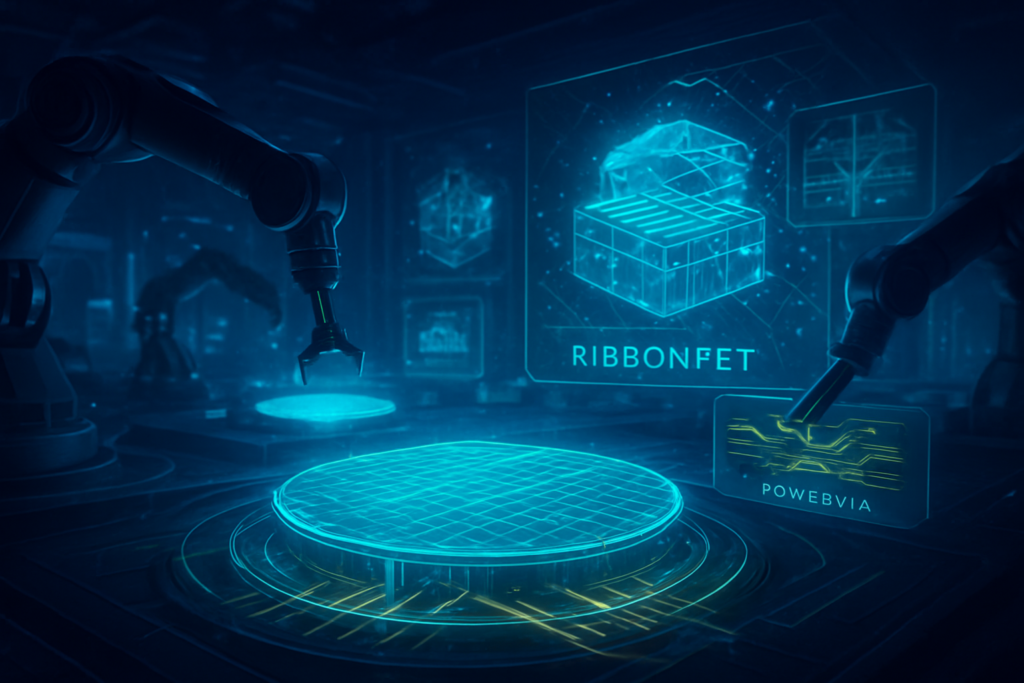
The transition to Intel 18A is defined by two foundational technical breakthroughs that separate it from previous FinFET-based generations. The first is RibbonFET, Intel’s implementation of Gate-All-Around (GAA) transistor architecture. Unlike traditional FinFETs, where the gate covers three sides of the channel, RibbonFET features a gate that completely surrounds the channel on all four sides. This provides superior electrostatic control, significantly reducing current leakage and allowing for a 20% reduction in per-transistor power. This tunability allows designers to stack nanoribbons to optimize for either raw performance or extreme energy efficiency, a critical requirement for the next generation of mobile and data center processors.
Complementing RibbonFET is PowerVia, Intel’s proprietary version of Backside Power Delivery (BSPDN). Traditionally, power and signal lines are bundled together on the top layers of a chip, leading to "routing congestion" and voltage drops. PowerVia moves the entire power delivery network to the back of the wafer, separating it from the signal interconnects. This innovation reduces voltage (IR) droop by up to 10 times and enables a frequency boost of up to 25% at the same voltage levels. While competitors like TSMC and Samsung Electronics (OTC: SSNLF) are working on similar technologies, Intel’s high-volume implementation of PowerVia in 2025 gives it a critical first-mover advantage in power-delivery efficiency.
The first lead products to roll off the 18A lines are the Panther Lake (Core Ultra 300) client processors and Clearwater Forest (Xeon 7) server CPUs. Panther Lake is expected to redefine the "AI PC" category, featuring the new Cougar Cove P-cores and a next-generation Neural Processing Unit (NPU) capable of up to 180 TOPS (Trillions of Operations Per Second). Meanwhile, Clearwater Forest utilizes Intel’s Foveros Direct 3D packaging to stack 18A compute tiles, aiming for a 3.5x improvement in performance-per-watt over existing cloud-scale processors. Initial reactions from industry analysts suggest that while TSMC’s N2 node may still hold a slight lead in raw transistor density, Intel 18A’s superior power delivery and frequency characteristics make it the "node to beat" for high-end AI accelerators.
The Anchor of a New Foundry Empire
The success of 18A is the linchpin of the "Intel Foundry" business model, which seeks to transform the company into a world-class contract manufacturer. Securing "anchor" customers was vital for the node's credibility, and Intel has delivered by signing multi-billion dollar agreements with Microsoft (NASDAQ: MSFT) and Amazon (NASDAQ: AMZN). Microsoft has selected the 18A node to produce its Maia 2 AI accelerator, a move designed to reduce its reliance on NVIDIA (NASDAQ: NVDA) hardware and optimize its Azure cloud infrastructure for large language model (LLM) inference.
Amazon Web Services (AWS) has also entered into a deep strategic partnership with Intel, co-developing an "AI Fabric" chip on the 18A node. This custom silicon is intended to provide high-speed interconnectivity for Amazon’s Trainium and Inferentia clusters. These partnerships represent a massive vote of confidence from the world's largest cloud providers, suggesting that Intel Foundry is now a viable, leading-edge alternative to TSMC. For Intel, these external customers are essential to achieving the high capacity utilization required to fund its massive "Silicon Heartland" fabs in Ohio and expanded facilities in Arizona.
The competitive implications for the broader market are profound. By establishing a second source for 2nm-class silicon, Intel is introducing price pressure into a market that has been dominated by TSMC’s near-monopoly on advanced nodes. While NVIDIA and Advanced Micro Devices (NASDAQ: AMD) have traditionally relied on TSMC, reports indicate both firms are in early-stage discussions with Intel Foundry to diversify their supply chains. This shift could potentially alleviate the chronic supply bottlenecks that have plagued the AI industry since the start of the generative AI boom.
Geopolitics and the AI Landscape
Beyond the balance sheets, Intel 18A carries significant geopolitical weight. As the primary beneficiary of the U.S. CHIPS and Science Act, Intel has received over $8.5 billion in direct funding to repatriate advanced semiconductor manufacturing. The 18A node is the cornerstone of the "Secure Enclave" program, a $3 billion initiative to ensure the U.S. military and intelligence communities have access to domestically produced, leading-edge chips. This makes Intel a "national champion" for economic and national security, providing a critical geographical hedge against the concentration of chipmaking in the Taiwan Strait.
In the context of the broader AI landscape, 18A arrives at a time when the "thermal wall" has become the primary constraint for AI scaling. The power efficiency gains provided by PowerVia and RibbonFET are not just incremental improvements; they are necessary for the next phase of AI evolution, where "Agentic AI" requires high-performance local processing on edge devices. By delivering these technologies in volume, Intel is enabling a shift from cloud-dependent AI to more autonomous, on-device intelligence that respects user privacy and reduces latency.
This milestone also serves as a definitive answer to critics who questioned whether Moore’s Law was dead. Intel’s ability to transition from the 10nm "stalling" years to the 1.8nm Angstrom era in just four years demonstrates that through architectural innovation—rather than just physical shrinking—transistor scaling remains on a viable path. This achievement mirrors historic industry breakthroughs like the introduction of High-K Metal Gate (HKMG) in 2007, reaffirming Intel's role as a primary driver of semiconductor physics.
The Road to 14A and the Systems Foundry Future
Looking ahead, Intel is not resting on its 18A laurels. The company has already detailed its roadmap for Intel 14A (1.4nm), which is slated for risk production in 2027. Intel 14A will be the first process node in the world to utilize High-NA (Numerical Aperture) Extreme Ultraviolet (EUV) lithography. Intel has already taken delivery of the first of these $380 million machines from ASML (NASDAQ: ASML) at its Oregon R&D site. While TSMC has expressed caution regarding the cost of High-NA EUV, Intel is betting that early adoption will allow it to extend its lead in precision scaling.
The future of Intel Foundry is also evolving toward a "Systems Foundry" approach. This strategy moves beyond selling wafers to offering a full stack of silicon, advanced 3D packaging (Foveros), and standardized chiplet interconnects (UCIe). This will allow future customers to "mix and match" tiles from different manufacturers—for instance, combining an Intel-made CPU tile with a third-party GPU or AI accelerator—all integrated within a single package. This modular approach is expected to become the industry standard as monolithic chip designs become prohibitively expensive and difficult to yield.
However, challenges remain. Intel must now prove it can maintain high yields at scale while managing the immense capital expenditure of its global fab build-out. The company must also continue to build its foundry ecosystem, providing the software and design tools necessary for third-party designers to easily port their architectures to Intel's nodes. Experts predict that the next 12 to 18 months will be critical as the first wave of 18A products hits the retail and enterprise markets, providing the ultimate test of the node's real-world performance.
A New Chapter in Computing History
The successful launch of Intel 18A into High-Volume Manufacturing in December 2025 marks the end of Intel's "rebuilding" phase and the beginning of a new era of competition. By completing the "Five Nodes in Four Years" journey, Intel has reclaimed its seat at the table of leading-edge manufacturers, providing a much-needed Western alternative in a highly centralized global supply chain. The combination of RibbonFET and PowerVia represents a genuine leap in transistor technology that will power the next generation of AI breakthroughs.
The significance of this development cannot be overstated; it is a stabilization of the semiconductor industry that provides resilience against geopolitical shocks and fuels the continued expansion of AI capabilities. As Panther Lake and Clearwater Forest begin to populate data centers and laptops worldwide, the industry will be watching closely to see if Intel can maintain this momentum. For now, the "Silicon Throne" is no longer the exclusive domain of a single player, and the resulting competition is likely to accelerate the pace of innovation for years to come.
In the coming months, the focus will shift to the ramp-up of 18A yields and the official launch of the Core Ultra 300 series. If Intel can execute on the delivery of these products with the same precision it showed in its manufacturing roadmap, 2026 could be the year the company finally puts its past struggles behind it for good.
This content is intended for informational purposes only and represents analysis of current AI and semiconductor developments as of December 29, 2025.
TokenRing AI delivers enterprise-grade solutions for multi-agent AI workflow orchestration, AI-powered development tools, and seamless remote collaboration platforms.
For more information, visit https://www.tokenring.ai/.