In a move that redefines the scale of industrial investment in the digital age, OpenAI and SoftBank Group (TYO: 9984) have officially broken ground on "Project Stargate," a monumental $500 billion initiative to build a nationwide network of AI supercomputers. This massive consortium, led by SoftBank’s Masayoshi Son and OpenAI’s Sam Altman, represents the largest infrastructure project in American history, aimed at securing the United States' position as the global epicenter of artificial intelligence. By 2029, the partners intend to deploy a unified compute fabric capable of training the first generation of Artificial General Intelligence (AGI).
The project marks a significant shift in the AI landscape, as SoftBank takes the mantle of primary financial lead for the venture, structured under a new entity called Stargate LLC. While OpenAI remains the operational architect of the systems, the inclusion of global partners like MGX and Oracle (NYSE: ORCL) signals a transition from traditional cloud-based AI scaling to a specialized, gigawatt-scale infrastructure model. The immediate significance is clear: the race for AI dominance is no longer just about algorithms, but about the sheer physical capacity to process data at a planetary scale.
The Abilene Blueprint: 400,000 Blackwell Chips and Gigawatt Power
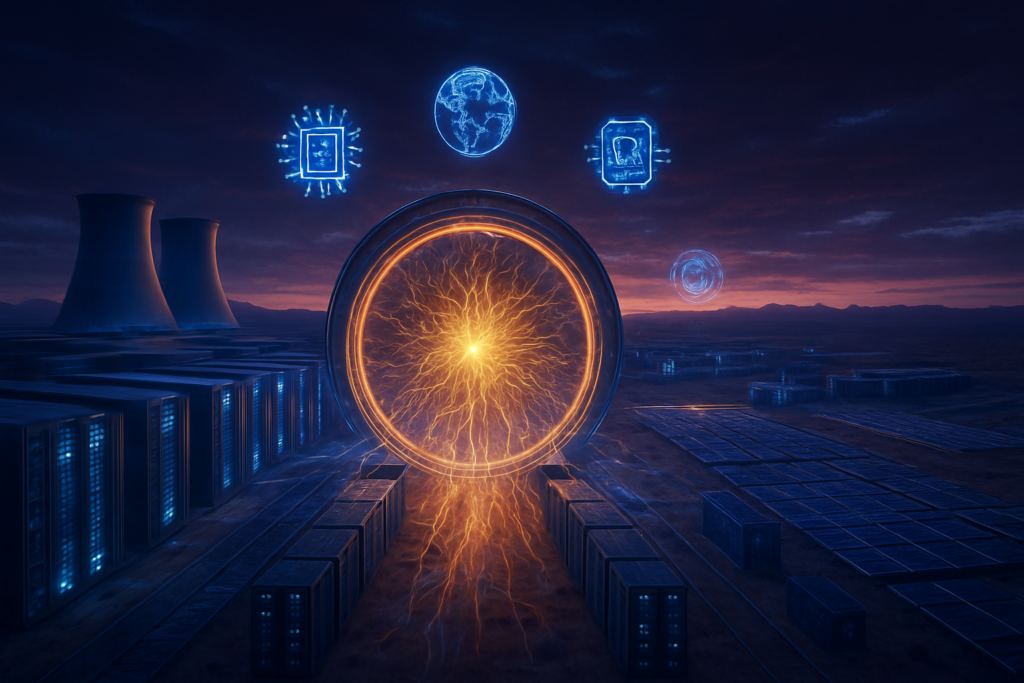
At the heart of Project Stargate is its flagship campus in Abilene, Texas, which has already become the most concentrated hub of compute power on Earth. Spanning over 4 million square feet, the Abilene site is designed to consume a staggering 1.2 gigawatts of power—roughly equivalent to the output of a large nuclear reactor. This facility is being developed in partnership with Crusoe Energy Systems and Blue Owl Capital (NYSE: OWL), with Oracle serving as the primary infrastructure and leasing partner. As of January 2026, the first two buildings are operational, with six more slated for completion by mid-year.
The technical specifications of the Abilene campus are unprecedented. To power the next generation of "Frontier" models, which researchers expect to feature tens of trillions of parameters, the site is being outfitted with over 400,000 NVIDIA (NASDAQ: NVDA) GB200 Blackwell processors. This single hardware order, valued at approximately $40 billion, represents a departure from previous distributed cloud architectures. Instead of spreading compute across multiple global data centers, Stargate utilizes a "massive compute block" design, utilizing ultra-low latency networking to allow 400,000 GPUs to act as a single, coherent machine. Industry experts note that this architecture is specifically optimized for the "inference-time scaling" and "massive-scale pre-training" required for AGI, moving beyond the limitations of current GPU clusters.
Shifting Alliances and the New Infrastructure Hegemony
The emergence of SoftBank as the lead financier of Stargate signals a tactical evolution for OpenAI, which had previously relied almost exclusively on Microsoft (NASDAQ: MSFT) for its infrastructure needs. While Microsoft remains a key technology partner and continues to host OpenAI’s consumer-facing services on Azure, the $500 billion Stargate venture gives OpenAI a dedicated, sovereign infrastructure independent of the traditional "Big Tech" cloud providers. This move provides OpenAI with greater strategic flexibility and positions SoftBank as a central player in the AI hardware revolution, leveraging its ownership of Arm (NASDAQ: ARM) to optimize the underlying silicon architecture of these new data centers.
This development creates a formidable barrier to entry for other AI labs. Companies like Anthropic or Meta (NASDAQ: META) now face a competitor that possesses a dedicated half-trillion-dollar hardware roadmap. For NVIDIA, the project solidifies its Blackwell architecture as the industry standard, while Oracle’s stock has seen renewed interest as it transforms from a legacy software firm into the physical landlord of the AI era. The competitive advantage is no longer just in the talent of the researchers, but in the ability to secure land, massive amounts of electricity, and the specialized supply chains required to fill 10 gigawatts of data center space.
A National Imperative: Energy, Security, and the AGI Race
Beyond the corporate maneuvering, Project Stargate is increasingly viewed through the lens of national security and economic sovereignty. The U.S. government has signaled its support for the project, viewing the 10-gigawatt network as a critical asset in the ongoing technological competition with China. However, the sheer scale of the project has raised immediate concerns regarding the American energy grid. To address the 1.2 GW requirement in Abilene alone, OpenAI and SoftBank have invested $1 billion into SB Energy to develop dedicated solar and battery storage solutions, effectively becoming their own utility provider.
This initiative mirrors the industrial mobilizations of the 20th century, such as the Manhattan Project or the Interstate Highway System. Critics and environmental advocates have raised questions about the carbon footprint of such massive energy consumption, yet the partners argue that the breakthroughs in material science and fusion energy enabled by these AI systems will eventually offset their own environmental costs. The transition of AI from a "software service" to a "heavy industrial project" is now complete, with Stargate serving as the ultimate proof of concept for the physical requirements of the intelligence age.
The Roadmap to 2029: 10 Gigawatts and Beyond
Looking ahead, the Abilene campus is merely the first node in a broader network. Plans are already underway for additional campuses in Milam County, Texas, and Lordstown, Ohio, with new groundbreakings expected in New Mexico and the Midwest later this year. The ultimate goal is to reach 10 gigawatts of total compute capacity by 2029. Experts predict that as these sites come online, we will see the emergence of AI models capable of complex reasoning, autonomous scientific discovery, and perhaps the first verifiable instances of AGI—systems that can perform any intellectual task a human can.
Near-term challenges remain, particularly in the realm of liquid cooling and specialized power delivery. Managing the heat generated by 400,000 Blackwell chips requires advanced "direct-to-chip" cooling systems that are currently being pioneered at the Abilene site. Furthermore, the geopolitical implications of Middle Eastern investment through MGX will likely continue to face regulatory scrutiny. Despite these hurdles, the momentum behind Stargate suggests that the infrastructure for the next decade of AI development is already being cast in concrete and silicon across the American landscape.
A New Era for Artificial Intelligence
The launch of Project Stargate marks the definitive end of the "experimental" phase of AI and the beginning of the "industrial" era. The collaboration between OpenAI and SoftBank, backed by a $500 billion war chest and the world's most advanced hardware, sets a new benchmark for what is possible in technological infrastructure. It is a gamble of historic proportions, betting that the path to AGI is paved with hundreds of thousands of GPUs and gigawatts of electricity.
As we look toward the remaining years of the decade, the progress of the Abilene campus and its successor sites will be the primary metric for the advancement of artificial intelligence. If successful, Stargate will not only be the world's largest supercomputer network but the foundation for a new form of digital intelligence that could transform every aspect of human society. For now, all eyes are on the Texas plains, where the physical machinery of the future is being built today.
This content is intended for informational purposes only and represents analysis of current AI developments.
TokenRing AI delivers enterprise-grade solutions for multi-agent AI workflow orchestration, AI-powered development tools, and seamless remote collaboration platforms.
For more information, visit https://www.tokenring.ai/.