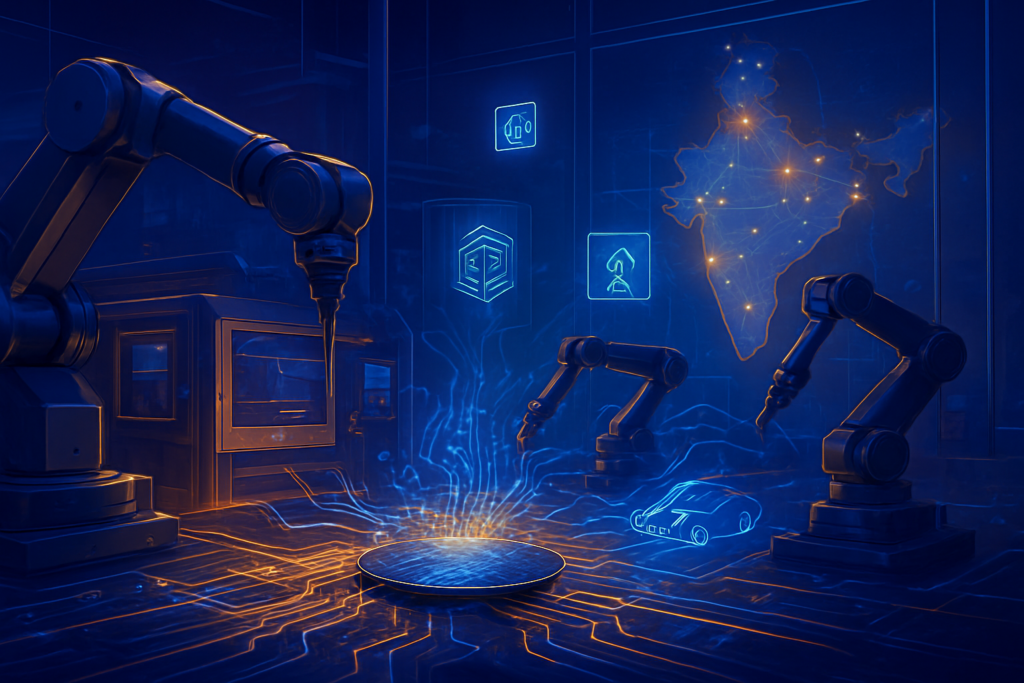
As of January 15, 2026, the global semiconductor landscape has officially shifted. This month marks a historic milestone for the India Semiconductor Mission (ISM) 2.0, as the first commercial shipments of "Made in India" memory modules and logic chips begin to leave factory floors in Gujarat and Rajasthan. What was once a series of policy blueprints and groundbreaking ceremonies has transformed into a high-functioning industrial reality, positioning India as a critical "trusted geography" in the global electronics and artificial intelligence supply chain.
The activation of massive manufacturing hubs by Micron Technology (NASDAQ: MU) and the Tata Group signifies the end of India's long-standing dependence on imported silicon. With the government doubling its financial commitment to $20 billion under ISM 2.0, the nation is not merely aiming for self-sufficiency; it is positioning itself as a strategic relief valve for a global economy that has remained precariously over-reliant on East Asian manufacturing clusters.
The Technical Foundations: From Mature Nodes to Advanced Packaging
The technical scope of India's semiconductor emergence is multi-layered, covering both high-volume logic production and advanced memory assembly. Tata Electronics, in partnership with Taiwan’s Powerchip Semiconductor Manufacturing Corporation (PSMC), has successfully initiated high-volume trial runs at its Dholera mega-fab. This facility is currently processing 300mm wafers at nodes ranging from 28nm to 110nm. While these are considered "mature" nodes, they are the essential workhorses for the automotive, 5G infrastructure, and power management sectors. By targeting the 28nm sweet spot, India is addressing the global shortage of the very chips that power modern transportation and telecommunications.
Simultaneously, Micron’s $2.75 billion facility in Sanand has moved into full-scale commercial production. The facility specializes in Assembly, Testing, Marking, and Packaging (ATMP), producing high-density DRAM and NAND flash products. These are not basic components; they are high-specification memory modules optimized for the enterprise-grade AI servers that are currently driving the global generative AI boom. In Rajasthan, Sahasra Semiconductors has already begun exporting indigenous Micro SD cards and RFID chips to European markets, demonstrating that India’s ecosystem spans from massive industrial fabs to nimble, export-oriented units.
Unlike the initial phase of the mission, ISM 2.0 introduces a sharp focus on specialized chemistry and leading-edge nodes. The government has inaugurated new design centers in Bengaluru and Noida dedicated to 3nm chip development, signaling a leapfrog strategy to compete in the sub-10nm space by the end of the decade. Furthermore, the mission now includes significant incentives for Compound Semiconductors, specifically Silicon Carbide (SiC) and Gallium Nitride (GaN), which are critical for the thermal efficiency required in electric vehicle (EV) drivetrains and high-speed rail.
Industry Disruption and the Corporate Land Grab
The commercialization of Indian silicon is sending ripples through the boardrooms of major tech giants and hardware manufacturers. Micron Technology (NASDAQ: MU) has gained a significant first-mover advantage, securing a localized supply chain that bypasses the geopolitical volatility of the Taiwan Strait. This move has pressured other memory giants to accelerate their own Indian investments to maintain price competitiveness in the South Asian market.
In the automotive and industrial sectors, the joint venture between CG Power and Industrial Solutions (NSE:CGPOWER) and Renesas Electronics (TYO:6723) has begun delivering specialized power modules. This is a direct benefit to companies like Tata Motors (NSE:TATAMOTORS) and Mahindra & Mahindra (NSE:M&M), who can now source mission-critical semiconductors domestically, drastically reducing lead times and hedging against global logistics disruptions. The competitive implications are clear: companies with "India-inside" supply chains are finding themselves better positioned to navigate the "China Plus One" procurement strategies favored by Western nations.
The tech startup ecosystem is also seeing a surge in activity due to the revamped Design-Linked Incentive (DLI) 2.0 scheme. With a ₹5,000 crore allocation, fabless startups are now able to afford the prohibitive costs of electronic design automation (EDA) tools and IP licensing. This is fostering a new generation of Indian "chiplets" designed specifically for edge AI applications, potentially disrupting the dominance of established global firms in the low-power sensor and IoT markets.
Geopolitical Resilience and the "Pax Silica" Era
Beyond the balance sheets, India’s semiconductor surge holds profound geopolitical significance. In early 2026, India’s formal integration into the US-led "Pax Silica" framework—a strategic initiative to secure the global silicon supply chain—has cemented the country's status as a democratic alternative to traditional manufacturing hubs. As global tensions fluctuate, India’s role as a "trusted geography" ensures that the physical infrastructure of the digital age is not concentrated in a single, vulnerable region.
This development is inextricably linked to the broader AI landscape. The global AI race is no longer just about who has the best algorithms; it is about who has the hardware to run them. Through the IndiaAI Mission, the government is integrating domestic chip production with sovereign compute goals. By manufacturing the physical memory and logic chips that power large language models (LLMs), India is insulating its digital sovereignty from external export controls and technological blockades.
However, this rapid expansion has not been without its concerns. Environmental advocates have raised questions regarding the high water and energy intensity of semiconductor fabrication, particularly in the arid regions of Gujarat. In response, the ISM 2.0 framework has mandated "Green Fab" certifications, requiring facilities to implement advanced water recycling systems and source a minimum percentage of power from renewable energy—a challenge that will be closely watched by the international community.
The Road to Sub-10nm and 3D Packaging
Looking ahead, the near-term focus of ISM 2.0 is the transition from "pilot" to "permanent" for the next wave of facilities. Tata Electronics’ Morigaon plant in Assam is expected to begin pilot production of advanced packaging solutions, including Flip Chip and Integrated Systems Packaging (ISP), by mid-2026. This will allow India to handle the increasingly complex 2.5D and 3D packaging requirements of modern AI accelerators, which are currently dominated by a handful of facilities in Taiwan and Malaysia.
The long-term ambition remains the establishment of a sub-10nm logic fab. While current production is concentrated in mature nodes, the R&D investments under ISM 2.0 are designed to build the specialized workforce necessary for leading-edge manufacturing. Experts predict that by 2028, India could host its first 7nm or 5nm facility, likely through a joint venture involving a major global foundry seeking to diversify its geographic footprint. The challenge will be the continued development of a "silicon-ready" workforce; the government has already partnered with over 100 universities to create a pipeline of 85,000 semiconductor engineers.
A New Chapter in Industrial History
The commercial production milestones of January 2026 represent a definitive "before and after" moment for the Indian economy. The transition from being a consumer of technology to a manufacturer of its most fundamental building block—the transistor—is a feat that few nations have achieved. The India Semiconductor Mission 2.0 has successfully moved beyond the rhetoric of "Atmanirbhar Bharat" (Self-Reliant India) to deliver tangible, high-tech exports.
The key takeaway for the global industry is that India is no longer a future prospect; it is a current player. As the Dholera fab scales toward full commercial capacity later this year and Micron ramps up its Sanand output, the "Silicon Map" of the world will continue to tilt toward the subcontinent. For the tech industry, the coming months will be defined by how quickly global supply chains can integrate this new Indian capacity, and whether the nation can sustain the infrastructure and talent development required to move from the 28nm workhorses to the leading-edge frontiers of 3nm and beyond.
This content is intended for informational purposes only and represents analysis of current AI and semiconductor developments.
TokenRing AI delivers enterprise-grade solutions for multi-agent AI workflow orchestration, AI-powered development tools, and seamless remote collaboration platforms.
For more information, visit https://www.tokenring.ai/.